

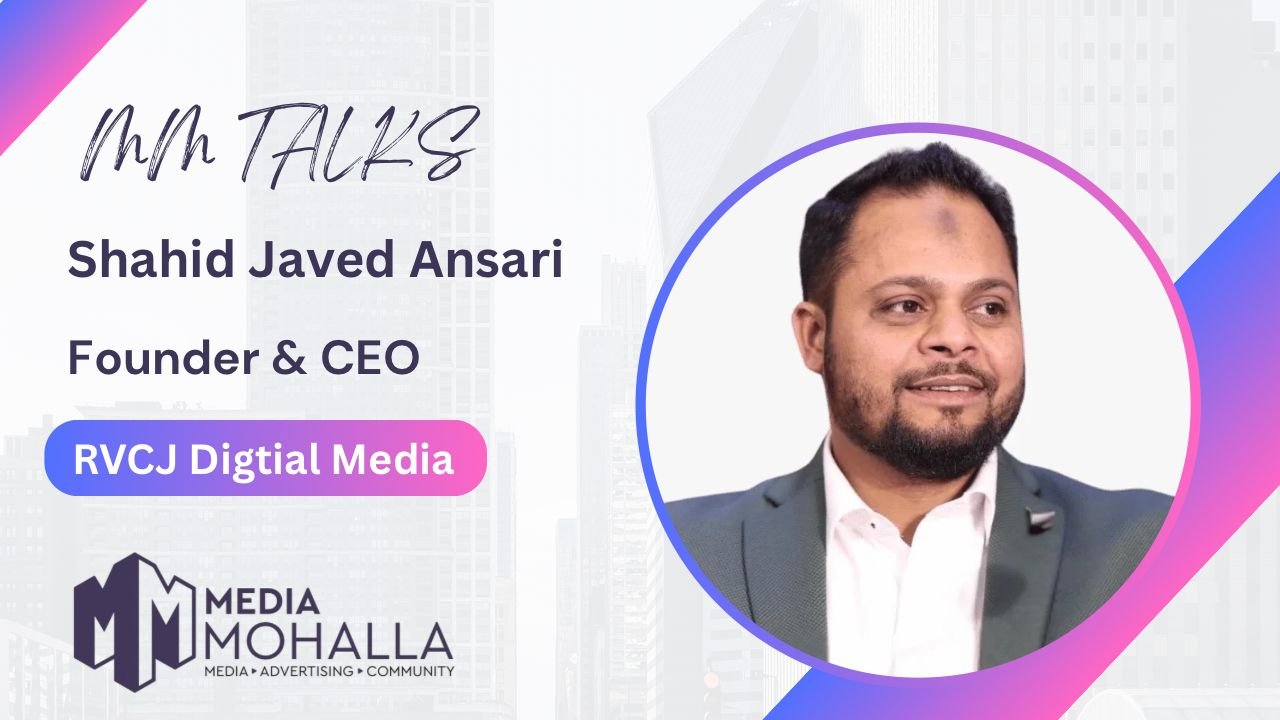
In this exclusive episode of Media Mohalla MM Talks, we sit down with Shahid Javed Ansari, Founder & CEO of RVCJ Digital Media, the entrepreneur who helped pioneer meme culture in India after launching RVCJ in 2010 as the iconic Facebook page Rajnikant vs CID Jokes. Over the years, Shahid transformed a viral meme platform into one of India’s leading digital media ecosystems, spanning entertainment, marketing intelligence, news, technology, original content, sports media, and now D2C commerce. Shahid shares his entrepreneurial journey, the evolution of meme marketing, the future of digital media, AI, content ownership, D2C commerce, and the importance of building brands rooted in audience trust.
1. RVCJ started as a meme page and evolved into a diversified digital media powerhouse. What were the key decisions that helped transform a viral content platform into a sustainable business ecosystem?
The single most important shift was refusing to treat virality as the business. Virality is a spike; a business is a system. Early on we asked ourselves a hard question – if the algorithm changed tomorrow, would we still exist? That fear forced discipline. We diversified our audiences across verticals instead of depending on one page, we invested in owned properties like Marketing Mind and The Logical Indian so we weren’t renting attention on borrowed platforms, and we built a team that thought like operators, not just creators. The other big decision was learning to say no — to content that got clicks but diluted what each brand stood for. Sustainability came from treating every property as its own identity with its own audience relationship, rather than one big undifferentiated pool of eyeballs.
2. RVCJ pioneered meme marketing in India long before brands fully embraced it. How do you see meme culture evolving as a serious marketing tool rather than just a social media trend?
Memes were never just jokes – they were the fastest-moving language of the internet, and we understood that early. What’s changed is that brands have stopped seeing memes as a “youth gimmick” and started seeing them as a distribution and relatability engine. A meme travels because people choose to share it; that’s earned attention, which is rarer and more valuable than paid attention. Going forward, meme culture will mature into something closer to real-time cultural commentary for brands — the ones who win won’t be the ones who force their logo into a template, but the ones who genuinely understand the joke and the community behind it. The risk is over-commercialization killing the authenticity. The opportunity is that a well-timed, culturally sharp piece of content can still outperform a crore-rupee campaign.
3. Through platforms like Marketing Mind, The Logical Indian, and RVCJ, you’ve built communities across different audience segments. What is your philosophy when it comes to building loyal digital communities at scale?
You don’t build a community by talking at people – you build it by consistently showing up with something they actually value, whether that’s a laugh, a perspective, or information they trust. Each of our platforms serves a different need: RVCJ for entertainment, Marketing Mind for industry intelligence, The Logical Indian for conscious storytelling. The philosophy underneath all of them is the same – respect the audience’s intelligence and their time. Loyalty at scale is a paradox, because scale usually kills intimacy. The way we manage that is by keeping each brand’s voice distinct and honest, so even with millions of followers, the audience feels like the content was made for them, not for everyone. Trust compounds slowly and breaks fast, so we protect it obsessively.
4. With audiences increasingly consuming short-form and creator-led content, how should brands balance performance marketing with authentic storytelling?
Performance marketing tells you what happened; storytelling decides whether anyone will care next time. The mistake brands make is treating them as opposing budgets instead of two halves of the same system. Performance gets you the transaction; story gets you the relationship – and relationships are what lower your cost of acquisition over time. My view is that authentic storytelling is long-term performance marketing; it just doesn’t show up neatly in this quarter’s dashboard. In a creator-led world, the story often can’t come from the brand alone — it has to come through voices the audience already trusts. So the balance isn’t 50-50 on a spreadsheet; it’s understanding that the brands winning today are the ones building narrative equity while everyone else is only buying clicks.
5. RVCJ recently partnered with CricTracker to strengthen its presence in the sports ecosystem. What opportunities do you see at the intersection of sports, content, and digital commerce in India?
Sport in India isn’t a category – it’s an emotion, and emotion is the most powerful commerce trigger there is. The CricTracker partnership was about owning a piece of that emotional real estate at scale. What excites me is the convergence: a fan watches content, engages with a community, and increasingly wants to act on that passion – buy merchandise, join a fantasy contest, back a brand a player endorses. That entire journey is collapsing into a single digital experience. India has hundreds of millions of sports fans coming online with money to spend, and most of that attention is still being monetised through basic advertising. The real opportunity is building the layer where content, community, and commerce meet – where a fan’s love for the game becomes a seamless path to participation and purchase.
6. You’ve successfully expanded from digital publishing into entertainment ventures through Salt Media and original content production. What challenges and opportunities come with moving from content distribution to content ownership?
Distribution is a great business until you realise you’re building someone else’s asset. When you distribute, your leverage is capped – you’re valuable only as long as you have reach. When you own the content, you own the IP, the upside, and the relationship with the audience directly. That’s the opportunity: durable, compounding value instead of rented reach. The challenge is that ownership is a completely different discipline. Distribution rewards speed and volume; ownership demands patience, capital, and the willingness to make bets that may not pay off for years. With Salt Media and original production, we’ve had to learn to think like studio operators, not just publishers – greenlighting, developing, and backing creative talent. It’s harder and riskier, but it’s the only way to move from being a channel to being a genuine media house.
7. The RVCJ group has steadily moved up the value chain from content distribution to content ownership, and now into D2C commerce with ventures like Rawbare. What’s the thinking behind expanding into physical consumer products, and how does owning audience attention give a media group an edge when launching a brand?
For years we’ve helped other brands reach and convert audiences – at some point the logical question becomes, why not build our own? That’s the thinking behind stepping into D2C. Rawbare, our D2C eyewear brand, is one expression of that – a venture the group is invested in and that’s being built by a dedicated founding team on the ground. The edge a media group brings is significant but often misunderstood. Most D2C startups spend their first few years and most of their capital just learning how to acquire attention; that’s the exact muscle we’ve spent a decade building. We understand audiences, content, and community at a level most product companies have to buy their way into. But I’m also realistic — attention gets you the first look, not the loyalty. A great product still has to earn its place. What we can do is compress the distance between a brand and the people who’ll love it, and that’s a real structural advantage when launching in a crowded market.
8. AI is reshaping content creation, audience targeting, and media operations. How do you believe digital media companies can leverage AI without losing the human creativity that drives engagement?
AI is the best assistant creativity has ever had and the worst replacement for it. My view is simple: use AI to remove friction, never to remove point of view. It’s brilliant for the unglamorous work research, editing, versioning content across formats, understanding what an audience responds to. That frees our teams to spend their energy on the thing machines can’t do, which is have a genuinely original take. What drives engagement is a human insight, a cultural nerve, a joke that lands because someone lived it. If media companies let AI generate the soul of the work, everything will start to feel the same, and sameness is death in this business. So we treat AI as leverage on human creativity, not a substitute for it. The companies that win will be the ones with the best taste, not just the best tools.
9. Looking ahead, what is your vision for the future of Indian digital media, and what role do you see RVCJ playing in shaping the next generation of content, creators, and brands?
I believe Indian digital media is heading toward a world where the lines between content, community, and commerce disappear entirely where a creator, a media house, and a brand can all be the same entity. India has the largest, youngest, most mobile-first audience on the planet, and we’re still in the early innings of how it gets served. My vision for RVCJ is to be at the centre of that convergence — not just as a content company, but as an ecosystem that creates original IP, builds and backs the next generation of creators, and launches brands that people genuinely love. We started by making India laugh. The ambition now is to build lasting institutions across content, entertainment, and commerce that outlast any single trend or platform.
Bonus – From making India laugh with memes to building one of the country’s most influential digital media networks, what has been your biggest leadership lesson as an entrepreneur, and what advice would you give to founders building media businesses today?
My biggest lesson is that in media, your only real moat is the trust of your audience and you can lose it faster than you built it. Everything else, reach, revenue, virality, is downstream of that trust. As a leader, my job is less about chasing the next viral moment and more about protecting the long-term relationship with the people who give us their attention. To founders building media businesses today, my advice is this: don’t fall in love with the spike. Anyone can go viral once. Build systems, build a team that can create without you in the room, and diversify before you’re forced to. And never outsource your judgment to an algorithm the algorithm optimises for today; your job is to build something that still matters in ten years.