

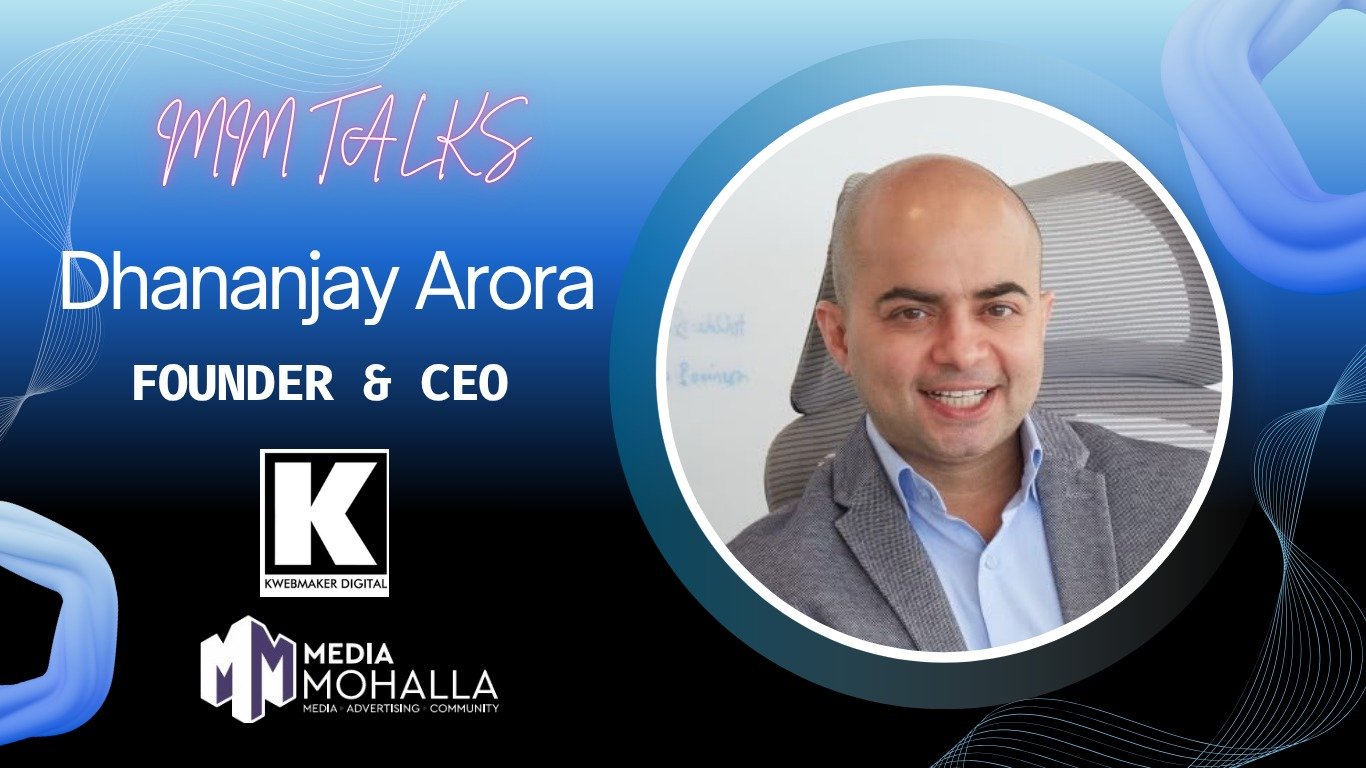
In this edition of Media Mohalla – MM Talk’s, we spoke with Dhananjay Arora is the Founder and CEO of Kwebmaker Digital, a digital and technology company he started in Mumbai in 1998. With over 28 years of experience in technology, digital strategy, ecommerce and marketing, he has seen the digital industry evolve from its early days to the AI era we are entering today.
Through his Digital & AI Transformation Advisory practice, Dhananjay works with business owners and leadership teams to help them make better decisions around technology, AI, data and marketing. His focus is on practical implementation, connecting systems and ensuring that technology investments contribute to real business outcomes.
Having worked across multiple industries and been involved in over 5,000 website projects, 500+ ecommerce platforms and 100+ mobile applications, he brings the perspective of someone who has spent decades building and implementing technology, not just talking about it.
Dhananjay was recognised as AI & Digital Transformation Leader 2026 by ET NOW – Times Network.
1. You have spent 25+ years building Kwebmaker and have now expanded into Digital & AI Transformation Advisory; what have those years of actually building and implementing technology taught you that a conventional consultant may not see?
When I started Kwebmaker in Mumbai in 1998, the internet was still very new in India. We were actually explaining to businesses why they needed a website in the first place! Today, we are talking about AI, automation and how technology can change the way an entire business works. It has been quite a journey.
One thing these years have taught me is that technology, by itself, doesn’t solve anything. It is what you do with it that matters.
When you are actually building and implementing solutions, you get to see what happens on the ground. You see how people work, where processes get stuck, why teams don’t always adopt new systems, and why something that looks great in a presentation may not work as well in the real world.
I’ve seen situations where a business invests in good technology, but the expected results don’t come because the underlying process was never right to begin with. And sometimes, a much simpler solution can make a bigger difference than an expensive new platform.
This is also what led me to Digital & AI Transformation Advisory. After spending so many years building and implementing technology, I felt I could bring a different perspective to business owners and leadership teams. Not just what they should do, but what is likely to work for them, what they should prioritise, and what they may be better off not doing.
I still enjoy building things. I also enjoy sitting across the table from a business owner and helping them figure out what needs to change. For me, the two go hand in hand.
2. You position yourself as both a Fractional CTO and Fractional CMO, why do you believe technology and marketing can no longer be treated as two separate boardroom functions?
I think this separation has become increasingly difficult to justify. Technology and marketing may have different responsibilities, but at the end of the day, both need to contribute to the same business objectives.
Let me give you a simple example. A company spends a substantial amount on digital marketing and generates hundreds of leads. But those leads aren’t captured properly in the CRM, the sales team follows up late, and nobody can clearly say how many of them actually became customers. Now, is this a marketing problem, a technology problem or a sales problem? In most cases, it is a bit of everything.
I’ve seen how easy it is for different departments to work hard at their own objectives without necessarily working together towards the larger business goal.
The same applies to technology. You can invest in a great platform, but if it doesn’t improve customer experience, help employees work better or contribute to growth, then we need to ask ourselves why we are investing in it.
This is why I believe technology and marketing need to be looked at together. One helps build the systems, data and infrastructure that a business needs. The other helps it reach customers, create demand and generate revenue. When they work in isolation, there are bound to be gaps.
My Fractional CTO + CMO approach is about bringing these two conversations together at the leadership level. It helps businesses look beyond individual departments and focus on what really matters.
I don’t think businesses necessarily need more technology or more marketing. They need to make sure that what they are already doing is working together and delivering results.
3. You specifically work with businesses in the ₹50 Cr+ bracket; what is the biggest technology or growth problem that typically appears when a company reaches this scale but its systems and processes have not evolved with it?
One thing I often see is that the business has grown, but the way it operates is still designed for a much smaller organisation.
When a company is small, a lot of things work because the founder knows everyone, decisions happen quickly, and people can manage information through spreadsheets, emails and personal follow-ups. There is nothing wrong with that in the early stages.
But as the business grows, it adds more people, departments, software, locations and marketing channels. Each addition solves a particular need, but over time, everything starts becoming disconnected.
Marketing has one set of numbers, sales has another, finance has its own reports, and operations may be working on a completely different system. The leadership team then spends more time trying to understand what is happening rather than deciding what to do next.
I sometimes describe this as a digital gap. The company has invested in technology, but it hasn’t necessarily changed the way the business operates.
At ₹50 Cr and beyond, these gaps start becoming expensive. Leads get missed, people spend hours preparing reports, decisions get delayed, and the business becomes increasingly dependent on a few individuals who know how everything works.
My first recommendation in such situations is usually not to buy another software platform. I prefer to first understand how the business works today, where the information is getting stuck, and what is preventing the leadership team from getting a clear picture.
Once that is understood, we can decide what needs to be integrated, what needs improvement and what genuinely needs to be replaced.
The idea is to help the business grow without making it unnecessarily complicated to run.
4. You often emphasise “integration, not addition” when it comes to AI, how can a CEO determine whether AI should be integrated into an existing workflow or whether the business genuinely needs a completely new technology solution?
I always tell business owners to start with the problem, not the technology.
Today, there is so much happening around AI that it is easy to get carried away. You see a tool doing something impressive, and immediately start thinking about how to use it in your business. But I think the first question should be: what are we actually trying to improve?
For example, if a sales team is already using a CRM but spends a lot of time researching prospects, updating records and preparing follow-ups, there may be no reason to introduce another platform. AI could potentially be integrated into the existing system to help with these tasks and make the team’s work easier.
But if the current system is unable to support the business, is very difficult to integrate, or has become a serious bottleneck, then a new solution may make sense.
There isn’t one answer that works for every business. I would look at the problem, the capabilities of the existing systems, the quality of the data and the likely business benefit. I would also consider whether employees will actually use the solution. This is often overlooked.
A tool can look wonderful in a demonstration, but that doesn’t mean it will work in the day-to-day reality of a business.
My view is quite simple. Don’t introduce AI just because everyone else is talking about it. Introduce it because it can make something meaningfully better.
Sometimes that means adding AI to an existing workflow. Sometimes the process itself needs to change. And sometimes you do need to build something new. The important thing is to get the sequence right.
5. Kwebmaker has delivered more than 5,000 websites, 500+ ecommerce platforms and 100+ mobile applications; after seeing the digital ecosystem evolve from websites to apps, cloud and now AI, what do you believe businesses are still fundamentally getting wrong about their digital foundation?
I think many businesses still confuse having digital assets with actually being digitally mature.
Having a website, an app, a CRM, an ERP and now a few AI tools doesn’t automatically mean you have transformed your business. The real question is whether these systems work together and help you serve customers better, operate more efficiently and make better decisions.
When we started Kwebmaker, the conversation was about getting businesses online. Then came ecommerce, mobile apps, cloud, digital marketing and now AI. Every new wave has created opportunities, but it has also encouraged businesses to jump onto the next big thing before fixing the basics.
And the basics haven’t really changed as much as people think. You still need reliable data, sensible processes, secure systems, a good customer experience and a clear understanding of what you want technology to achieve.
For example, if your customer data is scattered across different systems, or your website generates enquiries that nobody follows up properly, introducing AI isn’t going to magically fix everything. You may simply end up doing the wrong things faster!
Another area that I think businesses need to pay more attention to is discoverability. Having a website is one thing; making sure people can find you, understand what you offer and take the next step is quite another. Today, that also means thinking about how your business appears in AI-powered search and discovery platforms.
After working on thousands of projects, I feel the strongest digital foundation is not necessarily the one with the most technology. It is the one where the technology, people and processes actually work together.
6. In your advisory work, you have worked on AI-powered tender intelligence and AI-driven CRM and revenue intelligence; what separates an AI project that produces measurable business ROI from one that simply becomes another technology experiment?
For me, it starts with why the business is doing the project in the first place.
An AI experiment often begins with someone seeing an impressive tool or demonstration and wanting to try it out. There is nothing wrong with experimenting, of course, but at some point you have to ask what business problem it is solving.
Take tender intelligence, for example. Companies that deal with large volumes of tenders can spend a considerable amount of time going through documents, checking eligibility criteria and identifying relevant opportunities. AI can help with the initial review and extraction of information, allowing the team to focus on evaluating the opportunities that matter.
The value isn’t simply that AI can read a document. It is the time saved, the consistency of the review and the ability to get to the right information faster. Human review is still important, particularly when the decision has significant commercial implications.
Similarly, in CRM and revenue intelligence, the goal shouldn’t be to create more dashboards or send more automated messages. It should be to help sales teams understand their pipeline, identify opportunities that need attention and improve the way they follow up with prospects.
I usually look at a few things. Do we have a clearly defined problem? Do we know what the current process costs in terms of time, effort or missed opportunities? And after implementing AI, can we actually measure an improvement?
The other important factor is adoption. If employees find the solution difficult to use, or it sits outside their normal workflow, it may never deliver the expected value.
I prefer to start with a manageable use case, measure what changes and then expand from there. There is no point investing heavily in something simply because it looks impressive.
AI can do a lot of things, but the technology itself is not the ROI. The improvement it brings to the business is.
7. You have worked across manufacturing, real estate, BFSI, healthcare, education, automotive, media and events; which industry do you believe is currently underestimating the disruptive impact of AI the most?
If I had to pick one, I would say traditional manufacturing and industrial businesses, particularly those that have grown over several decades and still rely heavily on manual processes and individual experience.
Many of these are very well-run businesses with deep industry knowledge, strong customer relationships and years of operational experience. So I don’t think the opportunity is about throwing away what they have built. It is about using technology and AI to get more value out of it.
Think about the amount of information a manufacturing business deals with every day: product specifications, quotations, procurement, quality checks, maintenance records, inventory, dealer networks and customer enquiries.
There are many opportunities here. AI can help teams find information faster, assist with document-heavy processes, identify patterns in operational data and improve how sales teams respond to customers. In the right situations, it can also support quality checks and predictive maintenance.
Another area I find interesting is institutional knowledge. In many established businesses, a lot of important information sits with experienced employees. When someone leaves, or a key person is unavailable, accessing that knowledge can become difficult. AI-powered knowledge assistants can help make reliable internal information more accessible, with the right permissions and controls in place.
Of course, not every manufacturer is behind on AI. Some are already doing excellent work in automation and analytics. And there are equally significant opportunities in sectors such as real estate and professional services.
I think the real difference will be between businesses that start identifying practical use cases and building the capability to use AI, and those that keep waiting for the right time.
Interestingly, some of the biggest opportunities may not be in the most visible or exciting applications. They may be in the everyday processes where businesses lose time, information gets missed and decisions take longer than they should.
8. If you were appointed today as the Fractional CTO + CMO of a ₹100 Cr company that has disconnected data, multiple technology platforms and marketing spend that cannot be clearly linked to revenue, what would you fix first and what would you deliberately refuse to change immediately?
My first reaction would be to resist the temptation to change everything at once.
When a business has disconnected data, multiple platforms and no clear picture of marketing ROI, the immediate response is often to buy a new CRM, replace the ERP, introduce an analytics platform or change the entire marketing strategy. But unless you understand the underlying problem, you could end up spending a lot of money without really fixing anything.
I would first want to understand how the business works today, from the first customer interaction right through to sales, delivery and revenue.
I would focus on three questions. Where is the business losing visibility? Where are processes breaking down? And what information does the leadership team need but currently struggle to get?
From there, I would work on a few priorities.
First, get a reliable view of the business. Identify the key data sources, agree on what counts as a lead, an opportunity and a conversion, and understand which numbers management can actually trust.
Second, follow the customer journey. How does a marketing enquiry reach the sales team? How quickly is it followed up? Where are opportunities being lost? And can we connect marketing expenditure to actual business outcomes?
Third, fix the important integration gaps. Before replacing systems, I would check whether the existing platforms can be connected and whether better data flow and reporting could solve the problem.
Fourth, focus on a few improvements that can make a real difference. I would rather get two or three important things working well, with clear ownership and measurable outcomes, than launch ten initiatives at the same time.
As for what I would deliberately not change immediately, I wouldn’t replace an ERP or CRM simply because it is old. I wouldn’t recommend an expensive AI platform before understanding the quality of the data it will depend on. And I wouldn’t cut marketing channels just because their contribution isn’t immediately visible. I would first investigate the data, lead quality and role each channel plays in the customer journey.
There may be a good reason to replace a system or change the marketing mix later. But I would want those decisions to be based on evidence, not assumptions.
For me, the role of an advisor is not to come in and recommend a whole new set of tools. It is to help the leadership team understand what needs attention first and make the right decisions in the right order.
At the end of the day, the objective isn’t to make the company look more digital. It is to make the business more connected, more efficient and more profitable.