

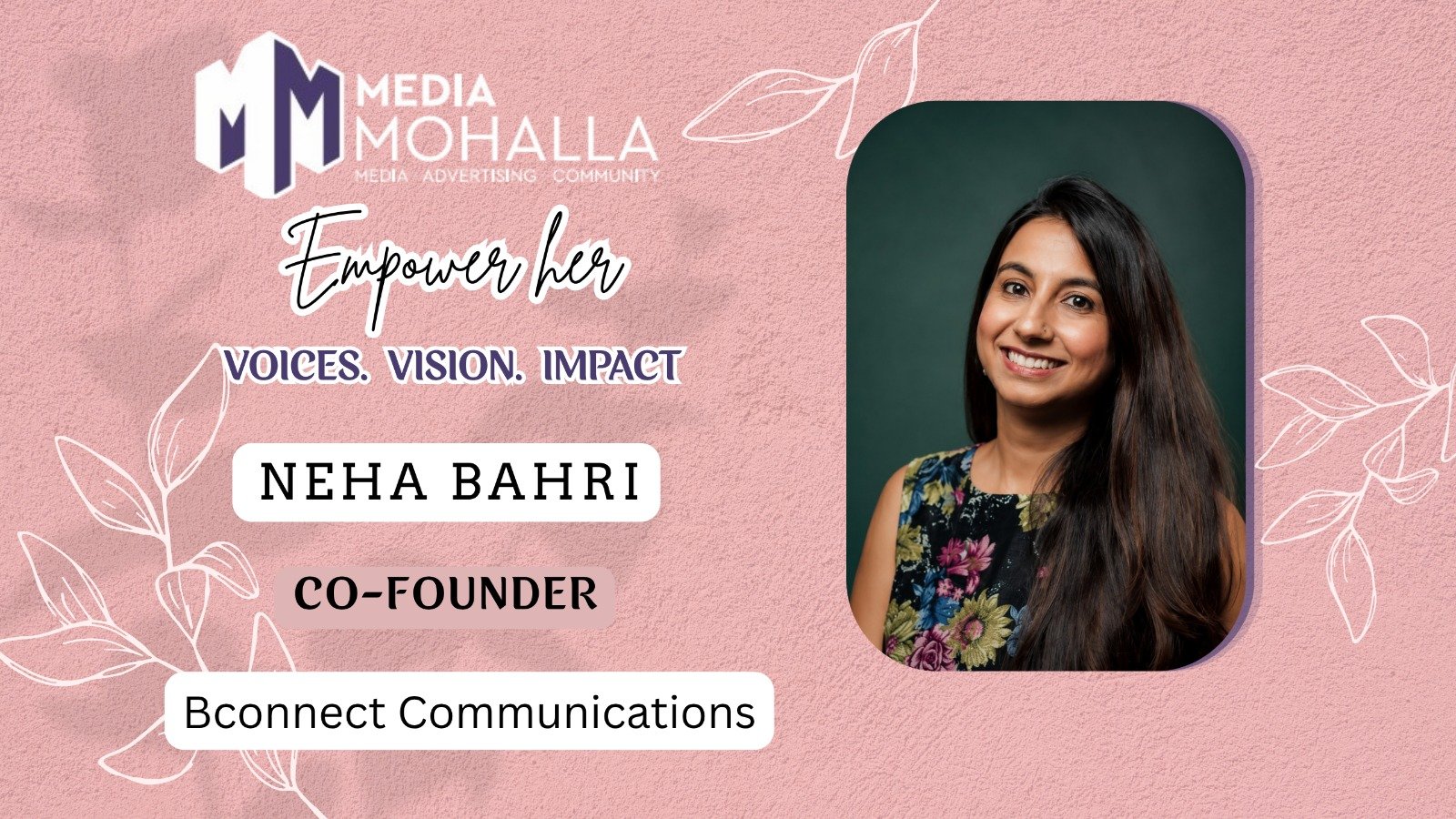
In our EmpowerHer Exclusive by Media Mohalla, we speak with Neha Bahri, Founder of Bconnect Communications, about her entrepreneurial journey, the evolving world of PR, and the power of building brands through credibility, authentic storytelling and meaningful influence.
Neha shares her perspective on founder-led communication, modern PR, leadership and her vision for helping future-ready businesses build lasting reputation and relevance.
1. You founded Bconnect Communications with a focus on helping startups, VC firms and future-ready companies get noticed. What gap in the traditional PR ecosystem made you feel there was a need for a different kind of communications approach?
I feel the biggest gap was that PR was often being treated as a visibility exercise rather than a business function. When I started looking at entrepreneurship seriously, I had already spent many years on both the agency and corporate side of communications. I had seen how brands approached PR, how agencies approached clients and, more importantly, where the disconnects were. Several conversations still started and ended with questions like, “How many stories can we get?” or “How much coverage can we generate?” However, for a startup or a growing company, the real questions exceed these superficial questions. What do you want people to believe about your company? What should an investor understand about the business? Why should a potential customer trust you? What should the market associate with your founder or leadership team? And how do you build that perception consistently over time? That was the thinking behind Bconnect.
On a personal front, the pandemic was certainly a turning point for me, as it allowed me to step back and think about what I wanted to build. Entrepreneurship had always been somewhere at the back of my mind, but I had been cautious about taking that leap. The pandemic made me realise that if I wanted to build something of my own, this was probably the time to do it. I wanted Bconnect to be more than an agency that pushed stories to journalists. I wanted it to be a partner that understood the business first and then figured out where communication could create an advantage. For me, good PR has always been a combination of science and art. There is strategy, data, timing and measurement, but there is also instinct, storytelling and an understanding of people. Every brand is a different puzzle, and that is what continues to make this industry interesting to me.
2. For startups and emerging companies, visibility is often critical but budgets are limited. How do you build a PR strategy that creates meaningful credibility and visibility without simply chasing media coverage?
The first thing I tell founders is: Don’t start with the media list. Start with the story. When budgets are limited, you have to be much more deliberate about where you spend your communication effort. You cannot try to be everywhere, and frankly, you don’t need to be. I would rather have a startup appear in a few relevant conversations where the audience actually matters than have it mentioned in twenty places that don’t influence its customers, investors, employees or partners. So we start by understanding the business. What is genuinely different about it? What problem is it solving? Why now? What does the founder know or understand that others in the market may not? Once we have those answers, we can identify the right narrative. And I think this is where PR has changed significantly.
A strong piece of earned media can do much more than generate a spike in visibility. It can become part of a company’s digital footprint. It can support founder credibility, help during investor conversations, create trust among potential customers and give the company a third-party validation that advertising cannot always replicate. I also don’t believe that PR should be reduced to a backlink-generation exercise. Backlinks can be useful, particularly when PR and SEO work together, but they shouldn’t become the reason we tell a story. If the only KPI is the number of links, we risk losing the actual purpose of PR, which is to build credibility and influence perception. So, for a startup, I would look at the quality of the audience, relevance of the publication, strength of the narrative, founder visibility, consistency and the business conversations that the coverage helps create. The objective isn’t simply to get noticed. It is to make the right people notice you for the right reasons.
3. Bconnect works across sectors rather than being restricted to one industry. How does a sector-agnostic approach influence the way you develop narratives for very different brands and founders?
Being sector-agnostic actually keeps us sharper. If you work in only one category for a very long time, there is always a possibility of falling into a formula. You know the usual stories, the usual publications, the usual messaging and eventually everything starts sounding similar. Working across sectors forces us to start from zero more often. A technology founder may be talking about an innovation, a healthcare company may need to establish scientific credibility, a consumer brand may need to create an emotional connection, while a VC firm may need to build authority around its investment thesis. The communication objective is different in each case, even if the fundamental principle remains the same. We don’t believe in taking a template and changing the logo. We first try to understand the business, the category, the competitive environment and, importantly, the person behind the brand. Then we ask ourselves: what is the conversation this company has a legitimate right to own? That last part is very important. You cannot manufacture thought leadership simply by giving someone a title and putting out ten articles. There has to be something behind it – experience, insight, data, a point of view or a genuine understanding of a problem.
The sector-agnostic approach also gives us an interesting advantage because ideas travel across industries. Something that works in one category can sometimes inspire a completely different approach in another. At the end of the day, sectors change, platforms change and media formats change. Human behaviour doesn’t change quite as quickly. People still respond to relevance, credibility, a good story and a point of view.
4. Today, founders themselves are becoming powerful communication channels. How important is founder positioning and personal branding in building trust for startups and VC firms?
It is extremely important, particularly for young companies. When a company is still building its identity, people often connect with the founder before they connect with the brand. They want to know who is building the company, why they are building it and whether that person understands the problem they are trying to solve. A founder can therefore become one of the strongest trust assets a company has. But I think there is a distinction between founder positioning and simply being visible on LinkedIn. Personal branding should not become a vanity exercise. A founder doesn’t need to comment on every trending topic or post every day just to remain visible. The real question is: what do you want to be known for? If a founder is building a fintech company, for example, perhaps they have a strong perspective on financial inclusion. If they are building a technology company, perhaps they have deep insight into how AI is changing their industry. If they are an investor, their investment thesis itself can become a point of view. That is where founder positioning becomes powerful. The founder’s voice should complement the company’s narrative, not compete with it. And authenticity matters enormously. Audiences today are very good at recognising when something has been manufactured. The most effective founder brands are usually built around what the person genuinely knows, believes and has experienced. For VC firms, I think this becomes even more interesting because the partners themselves can become intellectual assets of the firm. Their perspectives on markets, founders, technology and investing can help shape how the market perceives the firm long before a specific investment announcement happens.
5. The PR industry has moved from traditional press coverage to thought leadership, digital storytelling and founder-led narratives. What do you believe brands are still getting wrong about modern PR?
The biggest mistake is still confusing activity with impact. There is a tendency to look at PR as a checklist: press release, media pitch, interview, social post, founder article, repeat. But communication doesn’t work because we completed the checklist. It works when the audience actually remembers something. Another mistake is trying to say everything at once. Brands often have five different messages they want to communicate, and by the time the story reaches the audience, there is no clear message left. Clarity is underrated. The other thing I think brands need to rethink is the obsession with metrics that are easy to count but don’t necessarily tell us whether the brand moved forward. We are now seeing conversations around backlinks, impressions, reach, domain authority and other digital metrics. These have their place, but PR cannot become a numbers game where quantity automatically equals quality. I recently wrote about this very issue because the question “How many backlinks did we get?” has become increasingly common. My view is that PR and SEO should work together, but we should not reduce PR to link building. PR creates narrative, authority and trust; SEO can help amplify discoverability and longevity. They solve different parts of the problem.
And now AI is adding another layer to this conversation. The way people discover information is changing. Search is becoming more conversational, and people are increasingly asking AI systems to summarise companies, people, industries and trends. That makes credible, third-party information even more valuable. So I think modern PR needs to move from “How much coverage did we get?” to “What did that coverage change?” Did it strengthen the founder’s credibility? Did it improve how the market understands the company? Did it open a conversation with an investor or partner? Did it help establish a category? Those are much more meaningful questions.
6. As a woman founder leading a communications business, what has been your biggest leadership lesson while building Bconnect—and how has your own experience shaped the culture and way you work with clients?
My biggest leadership lesson has probably been that you cannot build a company by trying to do everything yourself. When you start something of your own, there is a natural tendency to be involved in every decision. You want to review everything, speak to everyone and make sure everything is done exactly the way you imagined it. But as the organisation grows, that approach stops working. You have to learn to trust people, give them ownership and allow them to find their own way of solving problems. I also think patience is one of the most underestimated leadership qualities. Communication is a people business. You are dealing with clients, journalists, founders, teams and sometimes very difficult situations. Everyone comes with a different personality, expectation and way of working. You cannot manage all of that with one leadership style. My own experience has made me particularly conscious of creating an environment where people feel that their ideas are heard. I want people at Bconnect to question things. If someone has a better idea than mine, I would much rather hear it than have them simply execute what I said. That same philosophy applies to clients. We don’t want to be an agency that says yes to everything just because the client asked for it. Sometimes our responsibility is to say, “I don’t think this is the right story,” or “I don’t think this is the right time,” or even “This may not achieve what you want it to achieve.” That honesty is part of the relationship. Building a business as a woman has also taught me that you don’t necessarily have to adopt someone else’s definition of leadership to be successful. You can be ambitious and empathetic. You can be commercially driven and still care deeply about people. For me, those things aren’t contradictory.
7. Looking ahead, what is your larger vision for Bconnect Communications? Do you see the agency evolving into a strategic communications partner that helps future-ready companies build not just visibility, but long-term reputation and influence?
Absolutely. That is actually the direction in which I see the business evolving. The definition of communications has expanded dramatically. It is no longer possible to put PR, digital, social media, content, influencer marketing, SEO and reputation into completely separate boxes and expect audiences to experience them separately. The audience sees one brand. So the communication strategy also needs to become more integrated. Our work today already goes beyond conventional media relations. We are looking at digital storytelling, founder positioning, influencer and creator ecosystems, social conversations and the broader digital reputation of a company. The next phase, for me, is about becoming an even stronger strategic partner to the businesses we work with. I want Bconnect to work with companies that are shaping what comes next—technology companies, startups, investors, innovators and future-facing businesses—and help them build a narrative that can grow with the company. Because reputation takes time. You cannot decide that you want to become a thought leader six weeks before a funding round and expect the market to suddenly believe you. The groundwork has to start much earlier. The same applies to crisis communication. You don’t build reputation during a crisis. You reveal the reputation you have built before the crisis. So yes, the long-term vision is definitely bigger than visibility. I want Bconnect to help brands build relevance, credibility and influence—and to be there as those brands move through different stages of growth.
Strong Closing Question
If “getting noticed” is the first step, what do you believe a brand needs to do next to become genuinely remembered, trusted and influential?
Getting noticed is relatively easy today. Staying remembered is much harder.
We live in a world where there is an enormous amount of content, information and noise. Everyone is trying to get attention. The scarce commodity is trust.
So after getting noticed, a brand needs to give people a reason to believe it. That comes from consistency.
Your story needs to match your actions. Your founder needs to stand for something. Your customer experience needs to support the promise you make. Your employees need to recognise the culture you talk about publicly. And when something goes wrong—as it inevitably will at some point—you need to communicate with honesty and accountability.
That is where reputation is built. I also think brands need to stop trying so hard to be memorable and instead focus on being meaningful.
A clever campaign may get attention for a week. A genuinely useful idea, a strong point of view or a company that solves a real problem can stay with people for years.
For me, the progression is quite simple:
- Visibility gets you into the conversation.
- Credibility gives people a reason to listen.
- Consistency gives them a reason to trust you.
- Relevance gives them a reason to remember you.
Ultimately, influence is not about how many people know your name. It is about whether your perspective carries weight when you are not in the room.
That is the kind of reputation I believe brands should be building.
Additional Thought
If there is one thing I would add to this conversation, it is that the future of PR is going to be much more closely connected to the future of business itself.
AI, changing search behaviour, creator-led communities and the fragmentation of traditional media are all changing how people discover and evaluate brands. But I don’t think this makes PR less relevant. I think it makes good PR more important.
The tools will keep changing. The platforms will keep changing. The way people consume information will keep changing.
However, the need for trustworthy information, human stories and trusted voices will timelessly remain relevant. That is what makes this industry exciting to me. We are not simply adapting PR to a new world. We are redefining what communications can do for businesses in that world.