

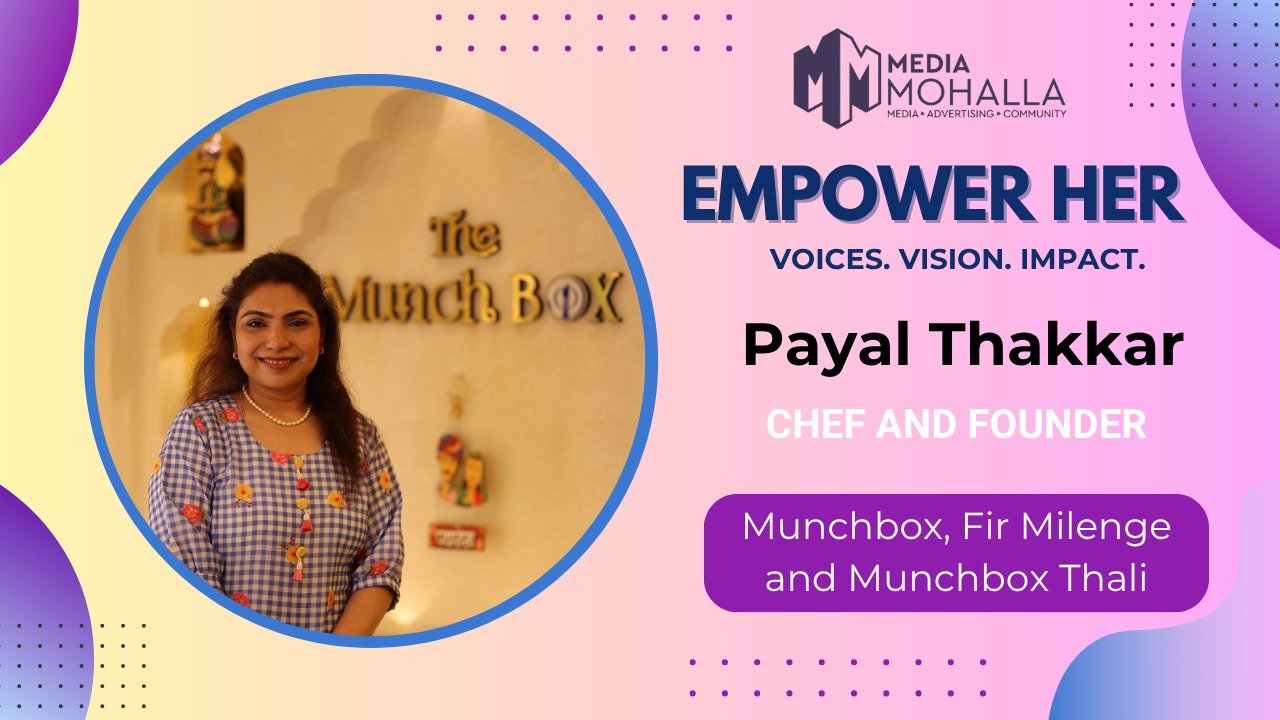
In conversation with Chef Payal Thakkar, Founder of Munchbox, Phir Milenge, and Munchbox Thali, for Media Mohalla’s Empower Her Exclusives
From a home kitchen in Mumbai to building a thriving multi-brand hospitality venture, Chef Payal Thakkar’s entrepreneurial journey is a testament to passion, perseverance, and purpose-driven growth. What began in 2014 as a small cloud kitchen serving comforting home-style meals has evolved into a hospitality portfolio that includes Munchbox, Phir Milenge, and the recently launched Munchbox Thali ,each concept offering a distinct dining experience while staying rooted in authenticity and customer connection.
An alumna of IHM Aurangabad, Chef Payal has successfully blended culinary expertise with business acumen, creating brands that resonate with diverse audiences—from everyday diners seeking comfort food to families looking for memorable dining experiences and guests craving authentic Gujarati and Rajasthani thalis.
Her growth story has never been about rapid expansion; instead, it has been guided by consistency, customer trust, and a deep understanding of hospitality. Through every venture, she has remained committed to creating spaces where food becomes a catalyst for connection, celebration, and shared memories.
In this edition of Media Mohalla Empower Her Exclusives, Chef Payal Thakkar shares insights into building multiple restaurant brands, understanding evolving consumer preferences, overcoming entrepreneurial challenges, and her vision for creating a lasting legacy in India’s hospitality industry.
1. Your journey began with Munchbox in 2014 and has now expanded into Fir Milenge and Munchbox Thali. What inspired you to build three distinct food brands and how has each one shaped your entrepreneurial journey?
Honestly, I never started with the goal of building multiple brands. My journey began in 2014 with Munchbox, which started as a home-run cloud kitchen driven by my passion for cooking and my desire to share comforting, home-style food with people.
In 2019, I took the next step by opening the first Munchbox restaurant, a 34-seater space. It was a significant milestone because it allowed us to connect with guests and create a more personal dining experience. The response encouraged us to dream bigger and in 2020 we moved into a larger space which marked a new phase of growth for the brand.
As the business evolved, I realised that people were looking for more than just good food. They were seeking experiences, conversations and meaningful moments. That insight inspired the launch of Fir Milenge in 2024, a brand built around the idea of bringing people together over great food, warm hospitality and memorable experiences.
In 2026, we launched Munchbox Thali, a concept that is especially close to my heart. It reflects my love for traditional Indian cuisine and the joy of sharing a complete, wholesome meal. Through Munchbox Thali, I wanted to celebrate India’s rich culinary heritage while offering guests a dining experience that feels nostalgic, comforting and authentic.
Each brand has its own identity and purpose but they are all connected by the same philosophy of bringing people together through food. Looking back, Munchbox, Fir Milenge, and Munchbox Thali represent different stages of my entrepreneurial journey, each teaching me new lessons and helping me grow both as a restaurateur and as a person.
2. Munchbox Fir Milenge and Munchbox Thali each have their own identity. How would you describe the role each brand plays in your larger hospitality vision?
For me, hospitality has never been only about serving food. It is about understanding why someone has walked through your door.
Munchbox represents everyday comfort. It is for those moments when you simply want a satisfying, familiar meal that feels honest and wholesome. Fir Milenge is a place for celebrations and moments where people can slow down and spend time with each other.
Munchbox Thali, on the other hand, is rooted in nostalgia and tradition. It celebrates the joy of eating together and the comfort of a complete Indian meal.
Each brand has its own identity, but they are all connected by one larger vision, to make people feel welcome, cared for, and connected through food.
3. From everyday comfort food at Munchbox to the experiential appeal of Fir Milenge and the traditional Gujarati Rajasthani thali experience at Munchbox Thali how do you balance creativity, authenticity and customer expectations across all three concepts?
I always ask myself one question before introducing anything new, does it feel true to the brand? Creativity is very important, but customers come back because they trust you.
At Munchbox, people look for comfort food that feels familiar and consistent. At Fir Milenge, they expect a more experiential space where the food, ambience, and overall mood come together. At Munchbox Thali, the expectation is authenticity and the joy of a traditional Gujarati and Rajasthani meal.
For me, the balance comes from respecting the core identity of each brand while still finding thoughtful ways to innovate. As long as we stay honest to what our customers expect from us, there is always room to be creative.
4. What was the thought behind launching Munchbox Thali as a dedicated thali brand and how does it complement the journey you had already built with Munchbox and Fir Milenge?
Growing up, I always felt that a thali is more than just a meal. It tells a story. Every bowl, every flavour, and every refill carries a sense of warmth and togetherness.
With Munchbox Thali, I wanted to create a dedicated space that celebrates this feeling in the right way. It was born from my love for traditional Indian food and the belief that a wholesome thali can bring back memories of home, family and festive meals.
It beautifully complements our other brands because while Munchbox and Fir Milenge focus on different dining occasions Munchbox Thali celebrates our roots.
5. Consistency is a major challenge when running multiple restaurant brands. How do you ensure quality taste and service remain strong across Munchbox Fir Milenge and Munchbox Thali?
Consistency comes from caring about the small things every single day. Customers may not remember every detail of their visit, but they always remember how a place made them feel.
For me, quality is not something that can be checked occasionally. It has to be part of the culture. I stay closely involved in tasting the food, reviewing customer feedback and working with my teams across all three brands. We have systems and processes in place to maintain standards, but beyond that, it is the passion, training and attention to detail that make the real difference.
6. As a woman entrepreneur in the hospitality industry, what were some of the biggest challenges you faced while scaling from one brand to three and how did those experiences shape your leadership style?
One of the biggest challenges was learning to trust myself. In the early days, there were many moments where my decisions were questioned or where people underestimated what I could achieve. As a woman entrepreneur, especially in hospitality you often have to prove yourself through consistency, patience and the ability to keep going even when things are difficult.
Over time, I realised that confidence does not come overnight. It comes from showing up every single day, staying committed to your vision and learning from every challenge along the way.
Those experiences made me a stronger leader and taught me the importance of resilience, patience and leading with empathy.
7. Each of your brands seems to connect with a different customer mood from comfort dining to casual experiences to family thalis. How do you understand what today’s diners are looking for?
I spend a lot of time observing people. Sometimes the best insights come from simply walking through the restaurant, listening to conversations and understanding how people respond to the food, the space and the overall experience.
Today’s diners are looking for more than just a good meal. They want experiences that feel genuine, comfortable and worth coming back to. They want great food, but they also look for warmth and authenticity.
For me, understanding these emotions is very important because every brand connects with people differently. When you understand what people are feeling, it becomes easier to create concepts that they truly relate to.
8. Customer trust has played an important role in your journey. How has customer feedback influenced the evolution of Munchbox Fir Milenge and Munchbox Thali over the years?
Customer feedback has influenced our journey a lot more than people realise. Some of our best decisions have come from simple conversations with our guests.
When customers keep coming back and openly share what they loved or what they feel can be improved, it becomes a very valuable learning opportunity. Their feedback has helped us shape our menus, improve our service and even think of new ideas for the brands.
I genuinely believe our customers have played an important role in building these brands alongside us.
9. Regional Indian food and homegrown restaurant concepts are seeing strong interest today. What opportunities do you see for brands like yours in the current dining landscape?
I think people are reconnecting with food that feels familiar and meaningful. There is a growing appreciation for regional flavours and stories behind the food.
For homegrown brands like ours, this creates a wonderful opportunity to celebrate our culinary heritage while presenting it in a way that feels fresh and relevant for today’s audience. It is not about changing the essence of the food but about making the experience more accessible.
I feel regional Indian food has a very strong future because it carries emotion and nostalgia.
10. Looking ahead, what is your long term vision for Munchbox Fir Milenge and Munchbox Thali and what legacy would you like to create in India’s hospitality space?
I would love to see Munchbox, Fir Milenge, and Munchbox Thali grow across cities, but for me, growth has never been only about numbers. My biggest goal is to build places that become a meaningful part of people’s lives.
I want our restaurants to be spaces where families celebrate milestones, friends reconnect and memories are created around a table. Food brings people together in such a beautiful way and I hope each of our brands continues to create that feeling.
Years from now, if people remember our brands not just for the food they ate but for the comfort they felt, that would be the legacy I would cherish the most.