

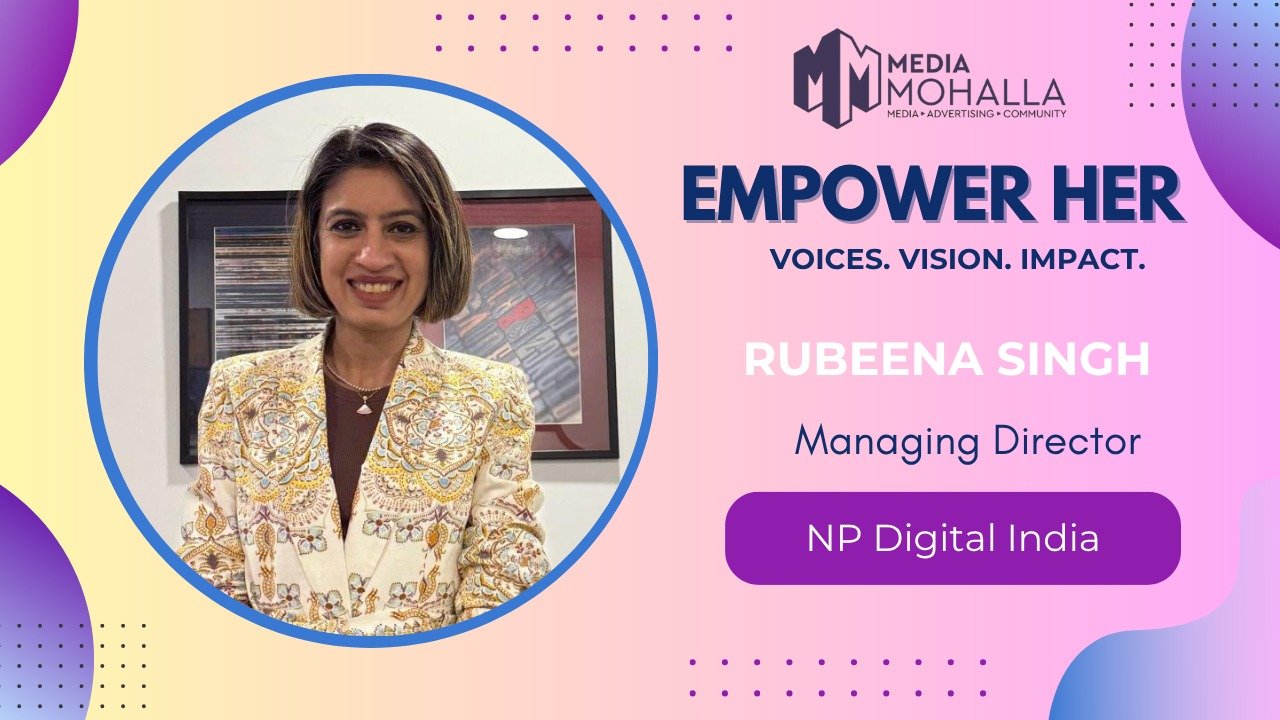
In Conversation with Media Mohalla – Empower Her Exclusives | Rubeena Singh, MD, NP Digital India Rubeena Singh’s
With over two decades of experience in the digital marketing and media industry, Rubeena Singh is a seasoned leader committed to driving business growth and operational excellence. As Managing Director of NP Digital India, she leverages her deep industry expertise to lead transformative strategies, ensuring the company stays ahead in an increasingly competitive digital landscape.
Before joining NP Digital India, Rubeena held prominent leadership roles, including CEO of iProspect India, COO at Moneycontrol, and Country Manager for Josh. At AnyMind Group, she successfully expanded operations into the UAE and Saudi Arabia, diversifying the business into new segments and driving significant regional growth.
Rubeena’s dynamic leadership and ability to navigate complex challenges have established her as a respected figure in the industry. At NP Digital India, she continues to push the boundaries of performance marketing, delivering measurable results and impactful solutions for clients across the globe.
1. From TV to digital leadership, how has your journey shaped your understanding of women in media leadership?
Television taught me the power of narrative and the discipline of working within structures that were largely traditional. Digital gave me something different: the ability to move faster, to build things, to see the impact of decisions almost in real time. Between the two, I developed a fairly clear-eyed understanding of how much of leadership is about adapting your instincts to a new context without losing what you fundamentally stand for.
The shift I have witnessed over the course of my career about women leaders is less about women becoming more capable and more about the industry slowly catching up to a capability that was always there. That, to me, is the more interesting story.
2. What’s one stereotype you had to consciously break while growing into leadership roles in this industry?
The idea that being likeable and being authoritative are somehow in conflict. There is a version of leadership that gets handed to women quite early: be agreeable, be collaborative, be the person who keeps the room comfortable. And those are not bad qualities. But there came a point where I had to become comfortable with the discomfort of disagreeing, of holding a position under pressure, of making a call that not everyone in the room was happy with.
Breaking that stereotype was less a single moment and more a gradual process of recognising that the warmth I brought to leadership did not need to come at the cost of conviction. The two can coexist, and in fact, the combination tends to be more effective than either quality alone.
3. You’ve been vocal about AI and LLM-driven discovery. How is this changing visibility for brands and voices, especially women-led narratives?
The shift from search to answers is one of the most significant changes in how consumers discover information, and it has implications that go well beyond brand marketing. When someone asks an AI platform for a recommendation or a perspective, the response draws on a body of content, citations and signals that has been shaped over multiple searches and context. Voices and narratives that have been historically underrepresented in credible, indexed, widely cited content are at risk of being underrepresented in AI-generated responses too.
For women-led narratives, this is both a challenge and an opportunity. The challenge is that visibility in an AI-first world is that historically the woman POV was not as much there. The opportunity is that the rules are still being written. Brands and individuals who invest in genuine thought leadership now, who show up consistently, have a real chance to shape how they are discovered and described by AI platforms in the years ahead.
4. Do you think today’s digital ecosystem truly empowers women creators, or are there still invisible barriers in reach and amplification?
Both things are true at the same time, and I think it is important to hold that tension honestly. The digital ecosystem has created access that simply did not exist before: a woman building a content platform in a Tier 2 city in India today has distribution options that no previous generation had. That is genuinely remarkable and worth acknowledging.
At the same time, the algorithms that determine reach and amplification were trained on engagement data that reflects existing biases in what gets attention and what does not. Content that conforms to certain formats, aesthetics and tones tends to travel further. That creates an invisible pressure to flatten or perform in particular ways to be seen, which is a different kind of barrier from the ones we talk about more openly. The creators who manage to build on their own terms, without shrinking themselves to fit the algorithm, are the ones I find most worth paying attention to.
5. In high-speed media environments, how do you maintain clarity while making critical decisions?
I have learned, over many years, that clarity under pressure is less about having all the information and more about knowing what actually matters in a given situation. The speed of the media and digital environment means you will rarely have complete information before a decision is needed. What you can have is a clear sense of your own principles, your organisation’s direction and the two or three variables that genuinely determine the outcome.
I also rely quite heavily on the quality of the people around me. Building a team you trust does not just improve execution; it improves the quality of the thinking you bring to your own decisions. When I am uncertain, I would rather have a quick, honest conversation with someone I respect than spend an hour alone trying to reason my way to certainty.
6. Who has influenced your leadership journey the most, and how do you now pay it forward for other women in the industry?
Interestingly, most of the people who have shaped my leadership have been men, simply because for much of my career, the senior roles around me were largely occupied by men. With the exception of one woman early in my career who showed me what it looked like to lead with both intelligence and grace, I did not have many female mentors along the way. That absence is something I carry with me, not with resentment but with a clear sense of responsibility.
It is why I take the sponsorship and mentorship of women on my team seriously, not just as a cultural value but as a personal commitment. I want to be the person I did not always have access to. That means advocating for women in rooms where they are not present, giving them ownership that stretches them and being honest with them in the way that actually helps rather than just reassures.
7. How has motherhood influenced your leadership style, emotional intelligence, or decision-making approach?
Motherhood recalibrated my sense of what matters and what does not, which turns out to be an incredibly useful quality in a leader. When you are responsible for a small person who is entirely dependent on you, you develop a tolerance for ambiguity and a capacity for prioritisation that no professional course can quite replicate.
It also deepened my empathy in ways I did not expect. Understanding what it feels like to be pulled in genuinely important directions simultaneously made me a more thoughtful manager of people who are navigating similar tensions. I became less interested in presence as a proxy for commitment and more interested in what people actually produce and how they show up when it counts. I think I am a better leader for having been through it, even on the days when the balancing act felt impossible.
8. What are the top skills young women should focus on today to stay relevant in an AI-first media world?
Three things, and none of them are technical in the traditional sense.
First, learn how to work with AI rather than around it. Understanding the technology is now a foundational literacy, not a specialisation.
Second, invest in your point of view. AI can assist tasks, but it cannot generate genuine perspective. The people who will be most valuable in an AI-first world are those who bring a distinct, well-reasoned way of seeing things.
Third, build your communication skills relentlessly. The ability to be clear, credible and persuasive is more valuable now than it has ever been. Those three skills together are very hard to replicate or automate.
9. Do you believe algorithms today still carry bias in how stories and voices are amplified?
Yes, and I think the more useful question is why, because the answer points to where the fix needs to happen. Algorithms optimise for engagement, and engagement data reflects the preferences and behaviours of the audiences that have historically dominated platform use. That creates a compounding effect: content that resonates with majority audiences travels further, gets more signal and is more likely to be amplified in future recommendations.
The bias is rarely deliberate at the design level, but it is real at the outcome level. For diverse voices, particularly women, regional voices and under-represented segments in India, this means that quality alone is not always sufficient for reach. Platform accountability, more representative training data and deliberate investment in surfacing underrepresented voices are all part of the answer. It is a solvable problem. It just requires the platforms and the industry to be honest about the fact that a problem exists.
10. If you had to give one honest, practical piece of advice to young women entering media and marketing today, what would it be?
Own your expertise out loud. Women are often socialised to let their work speak for itself, to stay quiet and trust that good performance will be recognised. And sometimes it is. But in an industry that moves as fast, credibility may not be an automatic rewards for quiet competence. You have to participate in the conversation, share your thinking, take up the space in the room and contribute your perspective without waiting to be asked.
This is not about self-promotion. It is about understanding that your expertise has value beyond the immediate task you are working on, and that the industry, your clients and the people coming behind you benefit when you share it. Get comfortable with that, earlier rather than later. The women I have seen build the most enduring careers in this industry are those who combined genuine ability with the confidence to be known for it.