

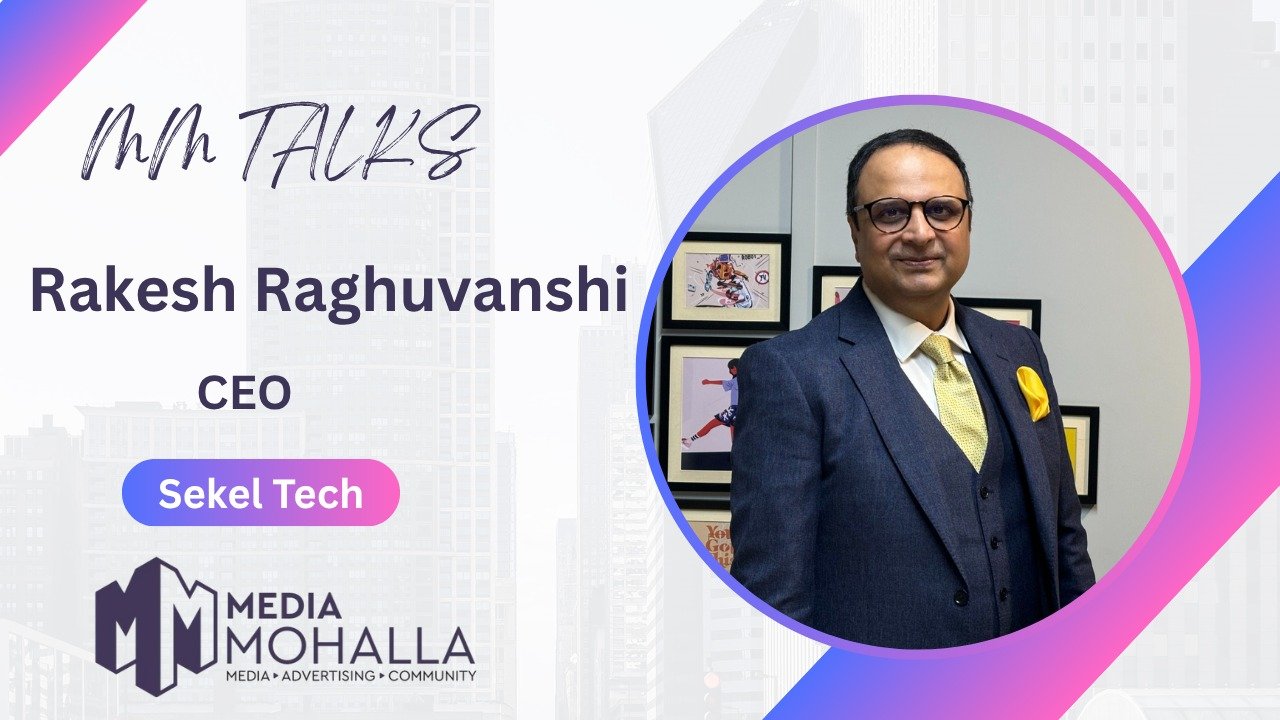
In our latest discussion, we speak with Rakesh Raghuvanshi, Founder & CEO of Sekel Tech, a seasoned digital marketing and analytics expert driving innovation in hyperlocal commerce. Under his leadership, Sekel Tech has emerged as a leading SaaS platform, empowering brick-and-mortar businesses with AI-powered Dynamic Engagement Commerce solutions that seamlessly connect online engagement with offline sales.
Rakesh shares his perspectives on Generative AI, hyperlocal marketing, customer engagement, data-driven attribution, and the future of digital commerce in an increasingly mobile-first world.
1 – The digital marketing ecosystem has traditionally focused heavily on online metrics, while businesses ultimately measure success through revenue and customer conversions. What inspired you to build Sekel Tech around the idea of connecting digital engagement with real-world, offline business impact?
As a product owner delivering discovery for local business across Google, YouTube and LinkedIn, I had had the opportunity to see the paradox up close. Brands had been spending enormous sums on digital, and yet the metrics they celebrated impressions, clicks, engagement rarely connected to revenue at the till, an aspect a Chief Financial Officer would actually value. In India, meanwhile, over 90 per cent of retail transactions still take place offline. They are done through dealers and retailers who were digitally invisible. Sekel Tech was born to help in closing that gap. The name come from the Hebrew word for wisdom and discernment. I strongly felt that the missing ingredient was never more software but the intelligence connecting digital intent to physical commerce.
2 – Hyperlocal commerce is emerging as a critical growth driver for brands with physical presence. From your experience, what are the biggest challenges businesses face in converting local digital intent into actual store visits and purchases?
Discoverability, distribution leakages and last-metre experience are challenges that stand out for me. Discoverability comes first because when a consumer searches “near me”, most brands simply do not appear. The reason is that dealer and store listings are fragmented, outdated or unclaimed. The distribution leak follows as demand signals die down as they pass from the manufacturer to carrying and forwarding agents to distributor to dealer to retailer. By the time data reaches the headquarters, decisions have degraded into assumptions. Finally, it is the last-metre experience that is challenging. Even after a consumer finds a store online, he finds inventory visibility, response times and local engagement to be broken. The consumer walks straight to a competitor. Solving hyperlocal commerce means resolving all three of the challenges simultaneously and not in silos.
3 – AI is transforming the way brands approach marketing, customer engagement, and decision-making. How do you see Generative AI and automation reshaping the future of advertising and customer experience over the next few years?
Advertising and customer experience is set to move from transaction-driven to intelligence-driven enterprises. The technology stack records, reports, reviews and reactions to everything today is quite backward-looking. The coming generation will detect, predict, recommend and automate in a continuous learning loop. The distance between insight and action will collapse with the Generative AI (Artificial Intelligence)-led transformation. Systems will start identifying a demand shift in a specific pin code and act on it within a few hours, instead of a marketer reading a dashboard and briefing an agency. People will start setting strategy and guardrails rather than pushing buttons as advertising becomes less about campaigns and more about orchestration of thousands of hyperlocal autonomous micro-decisions.
4 – Sekel Tech focuses on transparent attribution models that demonstrate the impact of digital marketing on offline sales. Why has measuring this online-to-offline journey remained such a complex challenge for enterprises, and how is technology changing this landscape?
Measuring an online-to-offline journey has remained challenging because it crosses organisational boundaries that were never designed to share data. A consumer’s search is more like taking place within a walled garden. The transaction takes place at an independent retailer, and the invoice sits in a distributor’s system, which the brand cannot access.
5. As consumer behaviour becomes increasingly mobile-first and personalised, what strategies should brands adopt to build deeper direct relationships with customers instead of relying only on traditional advertising channels?
Over the past decade, brands have been confusing “direct relationship” with “bypass the dealer”. This for me is the biggest strategic error brands are making today. In the process, a Direct-to-Consumer movement enterprise has led to brands believe that owning the consumer relationship means disintermediating their own distribution network, including distributors, authorised dealers and retailers.
For any brand that moves product through a physical channel will be commercially suicidal. This is especially true to categories like automotive, building materials, paints, FMCG and consumer durables, which still account for over 85 per cent of actual transactions. The real mobile-first strategy does not lie in being app-first. It is a local-search-first approach when a consumer picks up their phone and searches “tyre dealer near me” or “paint shop near me,” that is the single highest-intent moment in the entire purchase journey.
The conversion will be won by a brand that has digitally activated its authorised dealer network to capture that moment with accurate, optimized Google Business Profiles, localised content, real-time inventory visibility, and a seamless path from search to store visit to transaction. A brand that has not done this is hemorrhaging demand to competitors and to the grey market, every single day, at every single pin code. This is precisely why we built the D2R2C (Direct to Retailer to Consumer) model at Sekel Tech.
In our model brands do not bypass the retailer. The brand orchestrates demand digitally, the retailer fulfils it same day locally, and the consumer gets a personalised, proximity-driven experience. The retailer emerges as the hero of the digital journey, and not its casualty. Our OmniLocal Platform operationalises this as a closed loop. Hyperlocal Marketing captures the demand at the point of local search, Order2Cash converts that demand into auditable transactions flowing through the authorised distribution channel, and Geo Task Manager ensures on-ground compliance and outlet health across the entire network. The strategy brands need right now is distribution intelligence knowing, at every moment, whether their route-to-market network is digitally visible, commercially active, and operationally compliant. That is a fundamentally different capability from running campaigns and more advertising spend. What we do at Sekel Tech is offer an intelligence layer.
6 – Building a globally recognised technology company from India requires balancing innovation, scalability, and market understanding. What have been some of the key lessons from your entrepreneurial journey as a founder?
Architectural conviction has been my first and most consequential decision. We have ensured that Sekel Tech would not be a point solution that not just a listings management tool, a local SEO (Search Engine Optimisation) product and a field force tracker. We offer a full-stack platform that covers the entire route-to-market lifecycle.
This includes how a brand’s network is discovered online, how orders flow through the authorised channel, and how compliance is monitored on the ground. We follow a three-pillar architecture comprising Hyperlocal Marketing, Order2Cash, and Geo Task Manager which have not been designed in a strategy offsite. It was extracted from the market, from watching how enterprise brands in India actually lose revenue through what we call the Distribution Leak where the gap between demand generated and demand is fulfilled through the legitimate channel.
The second lesson was a commercial policy decision to stay away from pilots, POCs (Proofs of Concept), and have a full rollout from day one. Many told us it was reckless. But our reasoning was simple. A pilot across 50 outlets tells you nothing about whether a platform can govern 5,000 dealers across 600 districts. Enterprise brands do not have a pilot-sized problem, but a network-scale problem. If your platform cannot demonstrate that it works at full network scale from the first commercial engagement, you do not have a platform you have a prototype. Our decision has become one of our strongest commercial differentiators.
The third lesson was that global credibility is not a branding exercise. It is a governance exercise. We incorporated in the United Kingdom, and we pursued ISO 27001, SOC 2 Type II, UK GDPR (General Data Protection Regulation), DPA (Data Protection Act) 2018, and DPDP (Digital Personal Data Protection) Act certifications not because a client demanded it, but because we knew that if we intended to serve enterprise brands operating across regulated markets, our compliance posture had to be ahead of any procurement team’s checklist. That investment has paid for itself many times over.
The overarching lesson is that building an enterprise technology company from India that competes globally requires you to hold your nerve on architecture, on commercial policy, and on governance simultaneously. One cannot be world-class on product and casual on compliance. You cannot be claiming enterprise readiness and then offer a 30-outlet pilot because every decision compounds, and the market eventually rewards coherence.
7 – Looking ahead, what emerging trends in AI, data intelligence, and digital commerce do you believe will define the next decade of marketing technology, and where does Sekel Tech see itself contributing to this evolution?
The move from rule-based automation to Agentic AI (Artificial Intelligence) autonomous, goal-directed AI agents will be the defining shift of the next decade. These will not simply execute pre-programmed workflows but actively reason, plan, and act within defined governance boundaries. This will result in a change in how enterprise technology operates, because the constraint on scaling intelligent operations has never been the availability of data. We currently have an absence of trustworthy autonomous execution.
Brands have oceans of data location data, transaction data, inventory signals, field compliance logs and consumer behaviour patterns. But until now, the only way to act on that data at scale was to use either crude rule engines or expensive human intervention. At Sekel Tech, we have architected our platform around five Agentic AI Agents that operate across the OmniLocal stack, each responsible for a distinct domain of intelligence. These include demand sensing, channel health, compliance governance, inventory optimisation, and consumer engagement orchestration.
What makes this enterprise-grade rather than experimental is the governance layer we have added. Every agent operates under a Maker-Checker-Publisher framework. The agent proposes an action (Maker). A validation layer which can be algorithmic, human, or both audits the proposal against business rules, compliance constraints, and data quality thresholds (Checker). Only then is the action deployed into the live environment (Publisher). This is not a philosophical position but the way to prevent AI from making commercially catastrophic decisions at scale publishing incorrect pricing across 4,000 dealer listings, or triggering replenishment orders against phantom inventory.
The trend that will separate the winners from the noise in marketing technology over the next decade is not who has AI since everyone will adopt it. The separation will be who has governed AI operating at distribution-network scale, producing auditable commercial outcomes, not dashboards. Sekel Tech’s contribution to this evolution is the intelligence layer that sits between the brand and its entire route-to-market network making every node in that network digitally visible, commercially active, and autonomously optimised within governance guardrails that the enterprise controls. That is the future we are building, and we are building it now.