
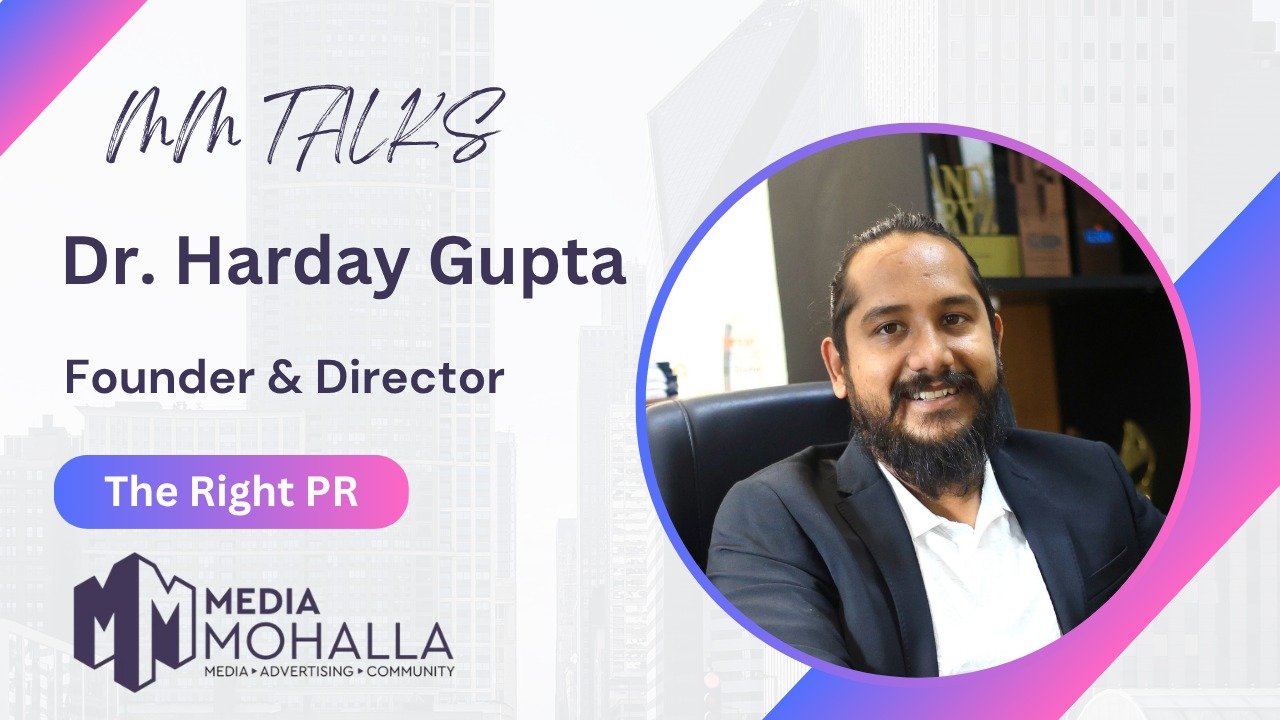
For our latest MM Talks feature, Media Mohalla sat down with Dr. Harday Gupta, Founder & Director of The Right PR, to decode what it really takes to build brands, manage reputations, and stay relevant in today’s fast-moving media landscape.
With more than a decade in public relations and a career spanning IPOs, startups, healthcare, real estate, lifestyle, and finance, Dr. Gupta brings both academic depth and hands-on industry expertise to the table. A Ph.D. holder in Public Relations and the driving force behind The Right PR, he has built an agency that prides itself on one core promise: “Your Image, Our Duty.”
From starting his venture in a highly competitive market to building a team-driven PR powerhouse, Dr. Gupta’s journey is one of persistence, strategy, and belief in the power of storytelling. In this exclusive interaction, he opens up about entrepreneurship, crisis management, influencer culture, and what effective PR truly means in 2026.
1. Harday, take us back to the beginning what inspired you to start The Right PR?
My inspiration wasn’t really born from one single “aha” moment, more like something I kept noticing again and again. The PR space felt packed with one-size-fits-all solutions, the kind that look great on paper but somehow miss the mark for real clients. There was this glaring gap between the shine of big national PR efforts and the day-to-day truth of what a business actually needs in order to grow a solid public image that sticks.
So I started The Right PR, partly because i wanted to build an agency that’s basically a one-stop, no-excuses setup. Our early principle, “Your Image, Our Duty,” wasn’t just words on a page it was a promise that we would take personal, steady ownership of a client’s reputation, even when it gets messy. I also wanted to show that you can be truly fluent in national media but still handle the finer details of regional and even hyperlocal PR too. That mix is somehow uncommon, and yet it’s also weirdly effective when you do it right.
2. You built a PR agency in a highly competitive space; what were your biggest early challenges?
Honestly, the biggest challenge, no doubt, was building a client base from scratch and somehow earning credibility at the same time. Back when we started, in April 2021, we were basically nobody, like an unknown speck drifting in a pool of established players. Almost every potential client kept coming back with the same question: Why should we trust you with our brand, if you don’t have any proof of results yet?
We didn’t have a portfolio full of big-name clients we could lean on, you know that comfort blanket. So we had to outdo ourselves on every single assignment, even when the job looked small on paper. We got extremely focused on two things, transparency and deadlines. We were always prepared with upcoming strategies for new prospects, and we made sure the whole process was simple to follow, not a maze with hidden corners. And slowly but surely, things started to move. The early clients turned into our biggest champions, and their testimonials—about our professionalism, our go-getter mindset, and our know-how in crisis management—ended up being the real deal, our most valuable kind of currency.
3. From handling clients across industries to building your own brand what shaped your entrepreneurial mindset?
The diversity of problems. One day it’s financial PR, the next it’s a startup launch. It kind of taught me that universal PR principles actually work across different sectors. And it forced me to think in a more strategic way—every choice, even our own brand building, has to mirror the expertise we’re selling, not just the vibe.
4. How has the PR industry evolved in the digital and influencer-driven era?
It’s moved from one-way broadcasting into real time , multi-directional conversations. PR, affiliate marketing, and influencer marketing sort of converged already. The most valuable creators act less like famous faces and more like trusted editors. Like, they curate and refine. Our work is to engineer where a story travels, from major outlets down to smaller niche creators, so it lands in the right places at the right time.
5. Today, anyone can create content, so what truly defines “effective PR” in 2026?
Effective PR is basically the signal that cuts through noise to build measurable trust. It’s earned storytelling—credibility you can’t buy—paired with performance data. Anyone can push out content. Effective PR is what creates real impact that turns into business results, you can feel it in the numbers.
6. You’ve worked on image and crisis management what’s the biggest mistake brands make during a crisis?
Silence, followed by hiding, or blaming somebody else. In the digital age, a vacuum gets filled with misinformation fast, every time. The right move is to address the issue head-on, even if you start with a holding statement. Accountability, not silence, is what protects your reputation.
7. How important is storytelling vs. data in modern PR campaigns?
Both of them aren’t just important; they feel almost inseparable. It’s not really a tug of war between “storytelling and data”; it’s more like a partnership, where both are needed. Data without a story is basically numbers that nobody remembers. A story without data is just a fairy tale, and honestly nobody really buys it.
At The Right PR, we use storytelling to shape consistent and credible narratives, and yes they help build a stronger brand image. Yet we also lean on data to stress test the message, steer the direction, and confirm the ROI. For example, when we’re forming a brand narrative, we don’t jump in blind. We begin with data: sentiment analysis, share of voice, audience demographics. That set of information basically shows us what story should be told, and also which people it should reach.
After that, we build a strong story and place it in the right channels, at the right moment. Then we circle back with data again to see what actually happened—was it picked up? Did it get shared? Did it shift market perception at all? In today’s world, if a financial PR campaign can’t turn complex information into a convincing story that lands with investors, it will just fail to move the needle.
8. “Your Image, Our Duty” is a strong statement; what does it mean in practical terms for your clients?
Practically speaking, it’s sort of a 360-degree commitment to taking ownership and delivering on our promises… like, all the way around. It means we don’t just advise from the sidelines; we’re in the trenches with our clients, 24/7. It also means you don’t have to stress about deadlines with us—we’re obsessively tuned to them.
It means absolute transparency. We always keep our clients in the loop, and make sure they are comfortably aligned with every activity we undertake. We don’t really believe in hidden agendas or reports that are stuffed with jargon for the sake of it.
Most concretely, it means we provide a unique value proposition: mastery of both national PR and hyperlocal PR. We have a strong advantage because we deliver PR that works on a national level at the same time it lands in specific regional markets, including tier-2 and tier-3 cities. We leave no stone unturned, and we go the extra mile to establish your firm as a proper brand in terms of media visibility.
9. In an age of misinformation, how can brands build trust with audiences?
With radical transparency and proactive credibility, keep it out there—don’t kind of wait for a crisis to arrive and then suddenly show up. Share your values, your expertise and yes, also the messy parts, openly. Get into rooms where CEOs are hanging out on LinkedIn, drop op‑eds, and really listen to stakeholders, not just broadcast at them. Trust is this consistent behaviour, not a polished claim, or whatever people like to say.
10. As a founder, how do you manage pressure, deadlines, and multiple clients?
Honestly, pressure is the price of admission. You kind of accept it once you start your own venture, even if you don’t love it at first. My approach is kind of built on a base of steadfast organisation and plain trust in my team.
I’m really organised, and I stay detail-minded. I get deadlines in my bones, and I always try to ship the best quality I can, even while things are getting tense. This part, the culture itself, is non-negotiable; we’ve built it at The Right PR.
But honestly, more important i surround myself with a team that shares the same DNA. We’ve got a “go-getter” mindset, and nobody at The Right PR ever says no to any type of work, no matter how challenging it gets. There’s this shared sense of responsibility, so we can juggle multiple projects at once by sorting out priorities in our workload. We also craft clean systems, and we give our people the autonomy to make decisions. That’s how i am not just putting out fires; I am leading a team that’s quietly paving roads proactively.
11. Lastly, what does “success” mean to Harday Gupta today?
Success isn’t just numbers anymore; it’s more like building resilient reputations for clients, where you can actually watch a startup turn into a proper brand. It’s also giving CEOs that quiet peace of mind, not just short-term results. And somewhere in there, it’s nurturing a positive workplace culture, raising the expectations for the entire PR industry—almost like setting a higher bar that sticks.