

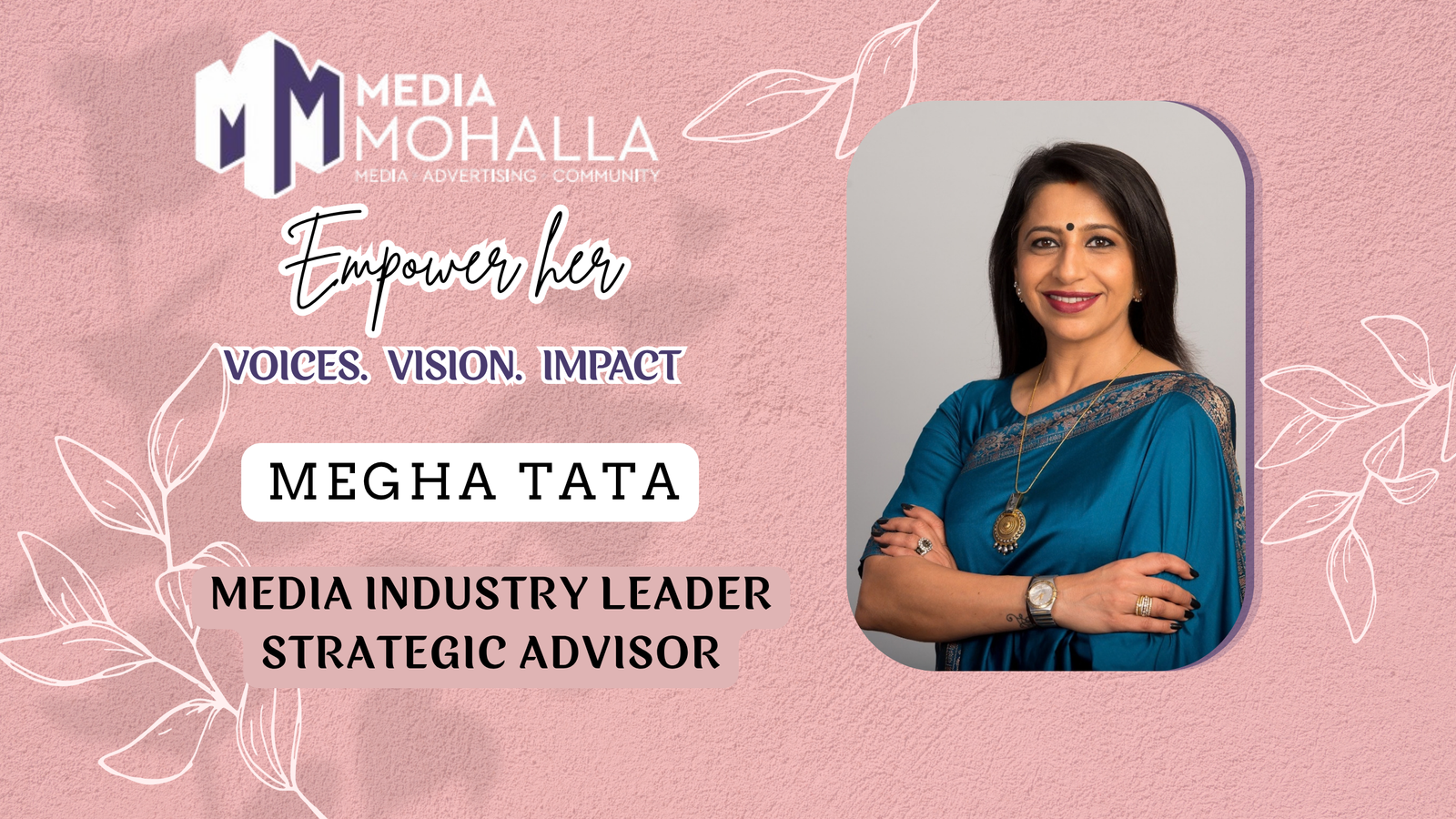
In this latest edition of Media Mohalla Empower Her, we speak with Megha Tata, a renowned media industry leader and Strategic Advisor with over three decades of experience across leading media organisations, including Star TV, HBO India, Discovery Communications and Cosmos-Maya.
A champion of women’s leadership and representation, Megha has played a significant role in shaping India’s media landscape. Join us as we explore her inspiring journey, leadership lessons and vision for the future of media.
1. You have built a career across some of the most influential media organisations and witnessed multiple phases of industry transformation. What, in your view, are the leadership capabilities that have become essential for navigating today’s rapidly evolving media landscape?
If there is one thing my three decades in media have taught me, it is that the only constant is change. I started my career when television itself was undergoing a revolution in India. Since then, I have seen satellite television, digitisation, streaming, social media and now AI reshape our industry – each time with predictions that the previous medium would disappear!
For me, the most important leadership capability today is adaptability without losing clarity of purpose. Leaders need to be comfortable saying, “I don’t know, but I’m willing to learn.” Curiosity has become as important as experience.
The second is the ability to make decisions amid ambiguity. We often don’t have the luxury of waiting until we have all the answers.
And finally, empathy. Technology may be transforming media, but ultimately ours is a business of people – people who create content, people who sell it and people who consume it. The best leaders will be those who can embrace technology without losing the human connection.
2. The media industry has moved from traditional television and print to digital, streaming, connected TV and now AI-led content ecosystems. How has this transformation changed the way senior leaders think about business strategy, consumer behaviour and monetisation?
Earlier, media businesses largely decided what audiences would watch and when they would watch it. Today, the consumer is firmly in control – of the screen, the format, the duration and increasingly even the experience.
That fundamentally changes strategy.
We can no longer think only in terms of platforms. We have to think in terms of attention. A television programme isn’t just competing with another television programme; it may be competing with a two-minute video, a gaming platform, a podcast or a creator on social media.
Monetisation therefore has to become equally fluid. Advertising and subscriptions will remain important, but increasingly the opportunity lies in building IP, communities, branded content, commerce and multiple revenue streams around audiences.
The biggest shift, however, is from “What do we want to show the consumer?” to “What does the consumer want from us?”
3. Having held leadership roles across different media businesses, what have you learned about building high-performing teams during periods of organisational transformation or market disruption?
I have always believed that people don’t resist change as much as they resist uncertainty.
During transformation, leaders sometimes become so focused on strategy, structures and numbers that we underestimate the anxiety within the organisation. People are wondering: What does this mean for me? Is my role relevant? Do I have the skills for what comes next?
Communication therefore becomes critical – even when you don’t have every answer.
I also believe strongly in empowering people. I have never wanted to be the smartest person in the room. I would much rather have people around me who know more than I do in their areas of expertise.
High-performing teams are created when people understand the destination, feel trusted to find the best route there, and know that their leader will stand behind them. In difficult times, trust is perhaps the most valuable currency a leader can build.
4. As media companies increasingly compete for consumer attention across multiple platforms, where do you see the biggest opportunities for sustainable growth and what business models do you believe will remain resilient over the next five years?
I believe the biggest opportunity lies at the intersection of content, technology and communities.
Audiences are becoming more fragmented, but paradoxically that fragmentation creates enormous opportunities. You don’t necessarily need hundreds of millions of consumers if you have a deeply engaged community that values what you create.
Strong IP will therefore become even more valuable. Content that can travel across platforms, formats, languages and even geographies can create multiple monetisation opportunities.
I also see significant potential in branded content. Consumers increasingly dislike interruption, so brands need to move from interrupting stories to becoming part of stories that people genuinely want to watch.
I don’t believe there will be one winning business model. The resilient businesses will be those that combine advertising, subscriptions, IP, partnerships, commerce and new revenue streams rather than depending excessively on one source.
Ultimately, platforms will keep changing. The ability to create something audiences genuinely care about will remain timeless.
5. Leadership today requires balancing commercial objectives with talent development, culture and stakeholder expectations. How do you approach this balance when making high-impact business decisions?
I don’t see commercial performance and culture as opposing objectives. In the long run, one sustains the other.
Of course, leaders have to deliver numbers. I have spent most of my career in businesses where targets, revenues, profitability and market share mattered enormously. But numbers are ultimately delivered by people.
When making difficult decisions, I try to ask three questions: Is it right for the business? Is it fair to the people affected? And can I explain the decision transparently?
There will always be moments when those interests don’t align perfectly. Leadership is not about avoiding those moments; it is about navigating them with clarity and integrity.
People may not always agree with your decisions, but they should understand why you made them and trust the intent behind them. For me, that trust is fundamental to leadership.
6. Women are increasingly entering senior management, but representation at the highest levels remains a challenge across industries. From a leadership and organisational perspective, what structural changes do you believe companies need to make to create a stronger pipeline of women leaders?
We have made progress in getting women into the workforce. The bigger challenge is ensuring that they stay, progress and reach positions where real decisions are made.
The drop-off often happens in the middle years – when careers accelerate at exactly the same time that responsibilities outside work can increase dramatically.
Companies therefore need to stop treating this purely as a women’s issue. Flexible working, meaningful return-to-work programmes, transparent promotion and pay structures, strong mentorship and sponsorship, and genuine accountability at leadership level all matter.
But there is another element I feel strongly about: we need to fix the system, not fix the women.
Women don’t need another workshop telling them to be more confident. Organisations need to examine whether their structures, cultures and unconscious assumptions allow talented women to succeed.
Representation also matters. When younger women see women in genuine positions of power, leadership stops looking like an exception and starts looking like a possibility.
7. You have worked across businesses with very different audiences, formats and operating models. How important has adaptability been in your leadership journey, and how do you preserve strategic consistency while adapting to fundamentally different market environments?
Adaptability has probably been one of the defining characteristics of my career.
I have worked across very different organisations, audiences and business models. Every move required me to learn again – sometimes to unlearn what had made me successful previously.
One lesson I learnt quite early is that you cannot copy-paste leadership. What worked in one organisation may fail completely in another because the people, culture, consumer and business realities are different.
What shouldn’t change are your values.
My leadership style has evolved considerably over the years, but some principles have remained constant: respect people, be transparent, take accountability, stay curious and never become so senior that you stop listening.
Strategies should adapt to circumstances. Values shouldn’t.
8. With AI beginning to influence content creation, audience analytics, advertising and media planning, what should senior media leaders be prioritising today to ensure their organisations remain competitive while maintaining creativity and human judgement?
I see AI as one of the most exciting transformations our industry has experienced – but I don’t see it as a substitute for human creativity.
AI can help us understand audiences better, personalise experiences, improve efficiencies, accelerate production and potentially democratise creativity. Leaders who ignore it will undoubtedly be left behind.
But we also need to distinguish between what AI can do and what AI should do.
Media ultimately deals with human emotion, culture, nuance and storytelling. Data can tell us what people watched; human judgement often tells us why it mattered.
So the priority for leaders should be to build organisations where people are encouraged to experiment with AI rather than fear it, while putting clear guardrails around ethics, copyright, authenticity and responsible use.
My view is simple: AI won’t replace creativity. But people who understand how to use AI intelligently will have an advantage over those who don’t.