
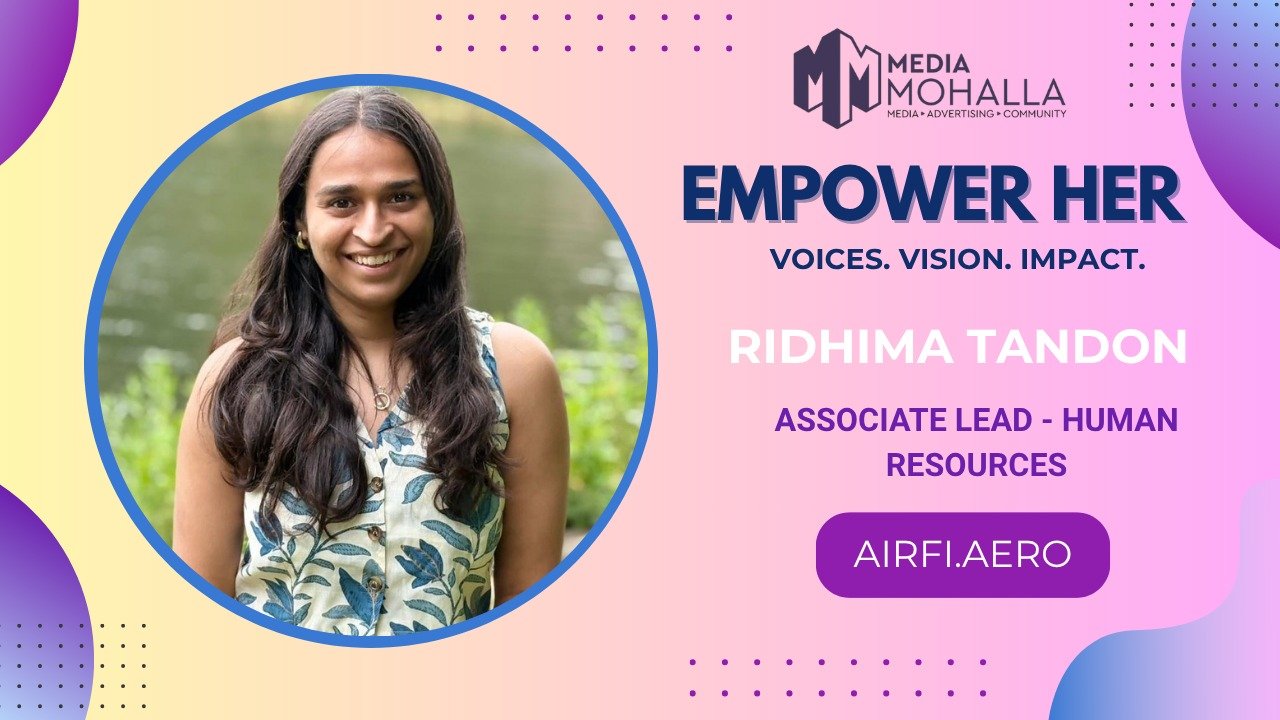
In Conversation with Media Mohalla – Empower Her Exclusives | Ridhima Tandon | AirFi.aero | Associate Lead – Human Resources
Ridhima Tandon is an HR professional with over five years of experience working in fast-paced, evolving environments where structure often needs to be built from the ground up. She holds a Master’s degree in Human Resources and is passionate about bringing clarity to ambiguity whether through designing processes, defining frameworks, creating global policies, or crafting meaningful engagement initiatives.
Currently at AirFi, Ridhima works across HR operations, policy design, and employee experience for globally distributed teams. Her role has largely involved stepping into complex scenarios, streamlining inefficiencies, and building systems that are not only effective but also sustainable as the organization scales.
She views HR not merely as a support function, but as a strategic driver of clarity, accountability, and long-term business impact.
Q1. With your foundation in financial markets, how has that shaped the way you evaluate human capital beyond just hiring metrics?
My exposure to financial thinking shaped one core belief early on – every decision needs to justify its return, including people decisions.
In HR, it’s easy to rely on surface-level metrics like time-to-hire or offer acceptance rates, but those don’t tell you whether you made the right hire.
I evaluate human capital more like an investment, asking questions like:
- What problem is this role solving?
- How does this hire improve team output or reduce friction?
- What is the cost of getting this wrong, not just financially, but operationally?
In a lean environment, where team size is reduced, but expectations remain constant, the impact of each hire becomes very visible. You quickly see which roles and individuals actually drive outcomes.
For me, hiring is not about speed or volume. It’s about bringing in people who meaningfully improve how work gets done.
Q2. In fast-paced industries, hiring often prioritises speed. How do you ensure the quality of talent isn’t compromised for urgency?
Speed matters, but unstructured speed is where quality breaks down.
In high-pressure situations, the focus should not be on slowing hiring, but on tightening the process. At AirFi, this meant building clarity by defining the role precisely, identifying non-negotiables versus trainable skills, and ensuring consistency in evaluation across interviewers.
In a lean setup, every hire carries weight. There is very little margin for error, which forces better decision-making.
The shift is simple: Urgency should not dilute standards; it should force you to define them better. That clarity allows you to move quickly without compromising quality.
Q3. You operate at the intersection of people, performance, and culture—which of these do organizations misunderstand the most?
Culture, because it is the most abstract and, therefore, the easiest to misinterpret.
Many organisations reduce culture to perks, engagement initiatives, or values on a slide. In reality, culture is far more operational. It is what gets rewarded, what gets tolerated, and how decisions are made under pressure.
A perspective that has stayed with me is this: “People who leave for compensation may return for culture, but those who leave because of culture rarely come back.”
In lean environments, culture becomes highly visible. There is no room to hide behind structure as ownership, accountability, and collaboration show up in everyday work.
At AirFi, culture is reflected in how we respond to real-life situations including supporting employees through milestones like childbirth, caregiving responsibilities, and career breaks. We have seen people return after stepping away, reinforcing that long-term relationships matter more than short-term convenience.
Even our shift to flexible and remote work was not just operational. It was a cultural commitment to enabling both performance and personal stability.
The mistake organisations make is trying to build culture as a separate initiative while In reality: Culture is already being built through everyday decisions and behaviours.
The question is whether it is being shaped intentionally or left to evolve by default.
Q4. Early in your HR journey, what has been more challenging to navigate—managing expectations of leadership or addressing concerns of employees?
Managing leadership expectations, because that is where the most complex trade-offs are made.
Employee concerns are usually visible and immediate. Leadership expectations, however, are layered – driven by business priorities, constraints, and long-term strategy, and often not explicitly articulated.
The challenge arises when these do not naturally align.
Early on, I realised HR’s role is not to “balance” both sides or keep everyone equally satisfied. That approach does not hold in high-pressure environments.
The real role is to bring clarity into decision-making by asking:
- What are we optimising for?
- What are we willing to compromise?
- What are the downstream consequences?
In lean teams, these decisions are highly visible. Every call directly impacts both people and performance.
Alignment comes not from trying to please both sides, but from making decisions intentional and transparent. When leadership understands the people impact, and employees understand the business context, conversations become far more constructive.
The challenge is not the decision itself, but it is maintaining that level of clarity and honesty consistently.
Q5. How do you approach cultural fit vs. cultural add when building teams in evolving work environments?
Cultural fit is often used as a safe filter, but in many cases, it ends up meaning “people like us,” which limits how teams evolve.
For me, cultural fit is non-negotiable at the level of values – ownership, accountability, and how individuals operate under pressure. Beyond that, I actively prioritise cultural add – differences in thinking, problem-solving, and perspective.
In fast-moving environments, it is tempting to hire for comfort – people who integrate quickly and reduce friction, but over time, that creates echo chambers and limits decision quality.
A question I consistently ask is: Will this person make the team more effective, or just more comfortable?
If someone aligns with core values but brings a different way of thinking, I would prioritise that, even if it introduces initial friction. Managed well, that friction leads to stronger outcomes.
The goal is not to build teams that blend in, but teams that can challenge, evolve, and operate with shared discipline.
Q6. With increasing reliance on data in HR decisions, where do you draw the line between insight and over-dependence on metrics?
I strongly believe that in a world where we are now relying heavily on AI, data should inform decisions but not replace judgment.
Metrics are valuable for identifying patterns such as attrition trends, hiring funnel gaps, or engagement signals. However, they rarely capture context like why someone is disengaged, how team dynamics operate, or the effectiveness of leadership.
Over-dependence begins when numbers become the decision, rather than the starting point for deeper inquiry.
In practice, I treat data as a diagnostic tool. It highlights where to look, but it needs to be validated through conversations and ground-level understanding.
Used well, data sharpens decisions. Used in isolation, it oversimplifies them.
Q7. What role do you believe HR should play in shaping employee narratives, not just policies?
HR’s role is not just to define policies. It is to shape how those policies are experienced and understood.
Policies provide structure. Narratives shape perception.
Most organisational decisions, whether restructuring, changes in ways of working, or shifting expectations, can be interpreted in multiple ways. The difference lies not in the policy itself, but in the clarity and honesty of the narrative around it.
If HR does not actively shape that narrative, it will be shaped anyway – through assumptions, partial information, and informal conversations. Those interpretations are often more damaging than the decision itself.
The role, therefore, is not to position decisions positively, but to:
- provide context
- acknowledge trade-offs
- and communicate with consistency and intent
Especially in fast-changing environments, people are more likely to accept difficult decisions when they understand the why and see alignment between what is said and what is done.
Ultimately, trust is not built through policies; it is built through how consistently and honestly those policies are brought to life.
Q8. In your experience, what’s one common hiring mistake organizations continue to repeat despite changing market dynamics?
One of the most common mistakes I continue to see is hiring for immediate need without thinking about long-term fit.
It often begins with urgency where roles need to be filled quickly, teams are stretched, and hiring becomes reactive. In that process, clarity of the role and alignment of expectations are the first things to get compromised.
On the surface, it feels like progress but this is where long-term inefficiencies begin.
This typically shows up as misaligned expectations, performance gaps, increased dependency on a few individuals, and eventually, higher churn, bringing the team back to where it started.
What I’ve learned is that even in constrained situations, taking the time to clearly define the role and align on what success looks like actually accelerates outcomes in the long run.
A delayed hire is manageable. A misaligned hire is expensive, operationally and financially.
Q9. How do you view the shift from traditional HR to strategic business partnering—is the transition real or overstated?
The shift is real but often misunderstood.
Many organisations equate strategic business partnering with visibility like being part of leadership discussions or aligning with business language. That alone does not make HR strategic.
The shift happens when HR starts taking ownership of business outcomes, not just people processes.
In lean environments, this becomes very clear. Every hiring decision, structural change, or performance call directly impacts execution speed, cost efficiency, and team effectiveness.
The real question is: Is HR influencing decisions in a way that changes outcomes?
From my experience, the gap is not in intent, but in capability. Many teams are still operating with traditional frameworks while being expected to deliver strategic impact.
So yes, the shift is real, but it requires HR to move beyond support and take accountability for how people decisions translate into business performance.
Q10. As workplaces become more transparent and employee-driven, what does “trust” look like today between organizations and their people?
Trust today is less about promises and more about consistency.
Employees do not expect perfection. They expect clarity, honesty, and follow-through.
In times of uncertainty, trust is built when organisations communicate openly, explain decisions rather than just implement them, and ensure alignment between what is said and what is done.
Difficult decisions do not necessarily break trust. Lack of transparency does.
Closing Note
My journey in HR so far has been shaped by stepping into ambiguity, taking ownership, and building systems that enable organisations to scale with clarity and consistency.
Across process transformation, organisational structuring, and people initiatives, my focus has remained on creating impact that is both immediate and sustainable.
What defines my approach is not just the range of work, but the level of ownership I have taken early in my career by contributing to decisions, leading initiatives, and operating beyond defined roles.
As I continue to grow, my goal is to evolve into an HR leader who builds organisations through strong systems, thoughtful culture, and intentional people practices, because ultimately, HR is not just about enabling growth.
It is about ensuring organisations grow with clarity, with purpose, and without losing the people who make that growth possible.