

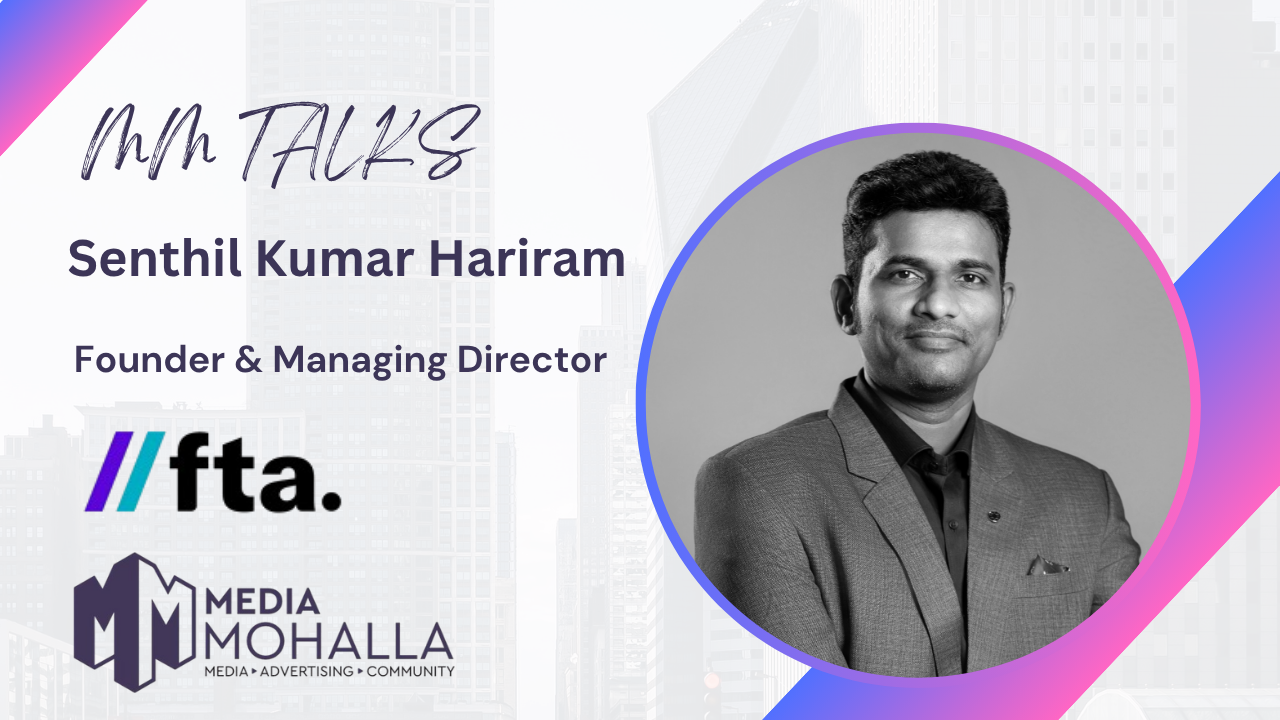
As part of its ongoing conversations with industry leaders shaping the future of marketing, Media Mohalla recently spoke with Senthil Kumar Hariram, Founder & Managing Director, FTA Global. In this exclusive interaction, Senthil shares insights on FTA Global’s first-year journey, the rise of Search Engineering, the impact of AI on brand discovery, the launch of FTA.Visibility, and the evolving role of marketers in an AI-first world.
As businesses navigate a rapidly evolving digital landscape influenced by artificial intelligence, changing consumer behavior, and new discovery platforms, marketers are being challenged to rethink traditional approaches to visibility and growth. In this conversation, Senthil discusses how FTA Global is helping brands adapt to this shift and why the future of marketing will be shaped by discoverability, intelligence, and adaptability.
- FTA Global has completed its first year of operations and established itself as a new-age marketing company focused on Search Engineering and AI-driven growth. What have been the defining moments of this journey, and what lessons have shaped the company’s evolution?
The past year has been both exciting and transformative for us. When we launched FTA Global, our vision was to build a marketing company designed for the future, one that could help brands navigate a rapidly evolving digital ecosystem shaped by AI, changing consumer behavior, and fragmented discovery channels.
One of the defining milestones has been partnering with more than 75 brands across industries and building a team of over 80 specialists within our first year. More importantly, we successfully introduced Search Engineering as a strategic discipline and helped brands understand that visibility today extends beyond traditional search engines.
The biggest lesson has been that adaptability is the most valuable asset in modern marketing. Technologies, platforms, and consumer expectations are changing faster than ever. Organizations that remain agile, invest in innovation, and stay focused on delivering measurable business outcomes will continue to thrive. Our first year reinforced our belief that the future belongs to companies that combine human expertise with AI-driven intelligence.
- FTA Global has positioned itself around Search Engineering rather than traditional SEO. What prompted this shift, and why do you believe Search Engineering is the future of digital marketing?
Search behavior has fundamentally changed. Consumers are no longer relying solely on search engines to discover brands, products, and services. Today, they are turning to AI platforms, conversational interfaces, recommendation engines, marketplaces, and social ecosystems to make decisions.
Traditional SEO was built around rankings and keywords. Search Engineering expands that approach by focusing on how brands are discovered across the entire digital ecosystem. It combines content strategy, technical optimization, AI visibility, structured data, user intent, and machine learning signals to improve discoverability wherever decisions are being made.
We introduced Search Engineering because we saw a clear shift in how information is consumed. The future of marketing will not be about ranking on a results page. It will be about becoming the most trusted and discoverable answer across multiple platforms and AI-powered environments. Brands that embrace this shift early will have a significant competitive advantage.
- As consumers increasingly rely on AI platforms such as ChatGPT, Gemini, and Perplexity for recommendations and information, how is brand discovery changing compared to traditional search engines?
Traditional search engines present users with a list of links and allow them to evaluate multiple options. AI platforms are fundamentally different because they generate answers, recommendations, and summaries directly within the conversation.
This means consumers are increasingly discovering brands through curated responses rather than browsing multiple websites. As a result, visibility is no longer determined only by rankings but also by how AI systems interpret a brand’s authority, relevance, credibility, and contextual value.
For marketers, this creates a new challenge. Brands must ensure their content is accurate, well-structured, authoritative, and accessible to AI systems. The focus shifts from optimizing for clicks to optimizing for inclusion in AI-generated answers. This transformation is reshaping the way organizations think about content, trust, and digital visibility.
- Many marketers still measure success through rankings, traffic, and conversions. What new metrics should brands focus on in the era of AI-driven search and discovery?
Traditional performance metrics will continue to be important, but they no longer provide a complete picture of visibility and influence. As AI-driven discovery grows, brands need to measure how frequently they appear in AI-generated responses, how they compare with competitors, and how consistently they are recommended across different platforms.
We are also seeing increased importance of metrics such as share of voice in AI environments, citation frequency, content authority, engagement quality, and customer trust signals. Understanding how users discover, evaluate, and interact with a brand across multiple touchpoints is becoming more valuable than tracking isolated performance indicators.
The brands that succeed in the future will be those that measure discoverability, credibility, and influence alongside traditional marketing metrics.
- FTA Global recently introduced FTA.Visibility. What market challenges or gaps inspired the development of this platform?
The idea behind FTA.Visibility emerged from a simple observation. Brands were investing heavily in SEO, content, and performance marketing, but very few had visibility into how they appeared across AI-powered platforms such as ChatGPT, Gemini, Perplexity, and other answer engines.
Marketing leaders could measure website traffic, rankings, and ad performance, but they lacked a reliable way to understand their presence in AI-generated recommendations. This created a significant blind spot as more consumers began relying on conversational AI for information and purchase decisions.
We developed FTA.Visibility to bridge this gap. The platform helps brands track, measure, and improve their AI visibility while providing actionable insights into how they are represented across emerging search and discovery environments. Our objective was to give marketers the same level of intelligence for AI-driven discovery that they have traditionally had for search engines.
- AI is transforming every aspect of marketing, from content creation and audience targeting to campaign optimization. How should organizations balance automation with human creativity and strategic thinking?
AI has become an incredibly powerful enabler, but it should not replace human judgment. The most effective marketing strategies emerge when technology and human expertise work together.
AI excels at processing large volumes of data, identifying patterns, generating insights, and automating repetitive tasks. However, creativity, empathy, storytelling, and strategic decision-making remain uniquely human strengths. These qualities are essential for building meaningful customer relationships and differentiated brand experiences.
Organizations should view AI as a force multiplier rather than a substitute for talent. The goal should be to free teams from routine tasks so they can focus on innovation, problem-solving, and strategic thinking. The brands that achieve the right balance between automation and human creativity will be the ones that create sustainable competitive advantages.
- Looking ahead, what are your priorities for FTA Global over the next 12 months, and what major shifts do you expect will reshape the marketing industry?
Our primary focus is to continue expanding our Search Engineering capabilities, strengthen our AI-powered solutions, and help brands prepare for the next era of digital discovery. We also plan to enhance FTA.Visibility and develop additional technology-led offerings that enable marketers to make smarter decisions in an increasingly complex ecosystem.
From an industry perspective, I believe we will see three major shifts. First, AI-generated discovery will become a mainstream channel for brand engagement. Second, marketers will place greater emphasis on first-party data and trust-driven experiences. Third, the distinction between marketing, technology, and analytics will continue to blur as organizations adopt more integrated growth models.
The future of marketing will be defined by discoverability, intelligence, and adaptability. Brands that embrace these principles will be best positioned to succeed in an AI-first world.