
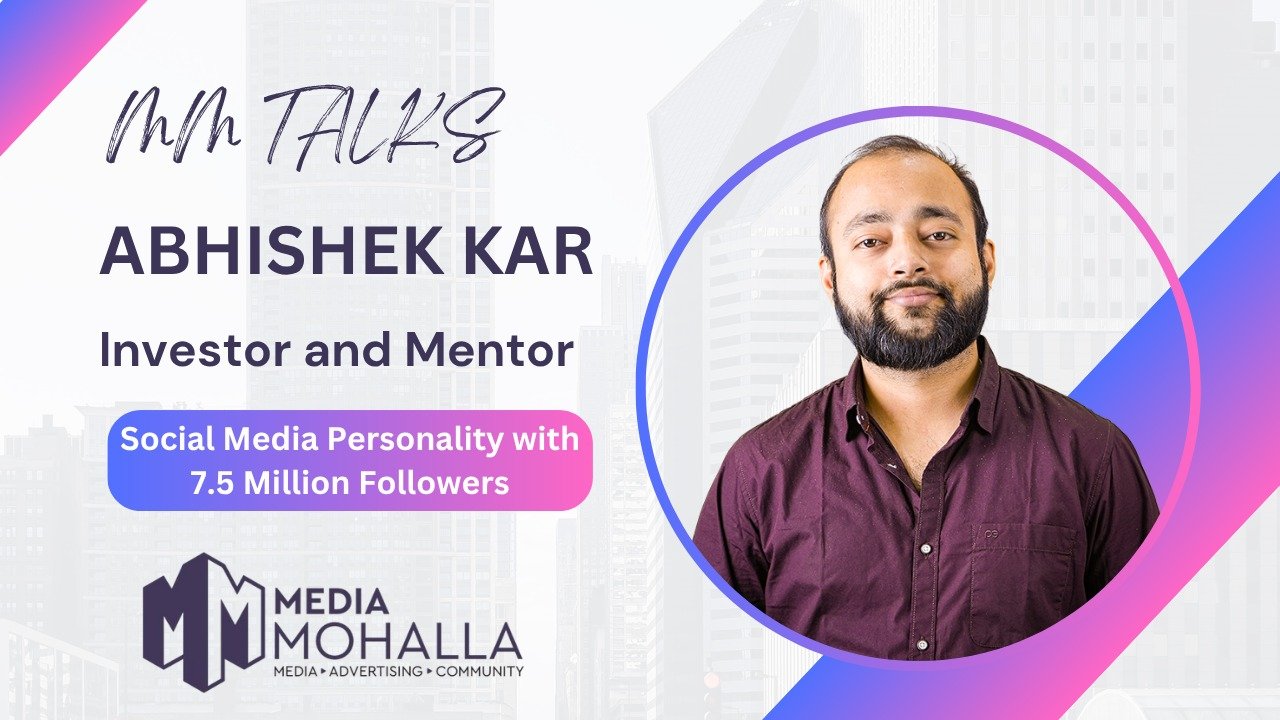
In Conversation with Media Mohalla MM Talk’s – Abhishek Kar | Investor, Mentor & Financial Educator | 7.5M+ Community Builder
Abhishek Kar is one of India’s most influential voices in financial education and behavioral investing, known for making complex market systems simple, relatable, and actionable for mass audiences. A TEDx speaker and author of Stocks and Life, he bridges the gap between institutional market thinking and everyday financial decision-making. With a digital reach of over 7.5 million people, he has built a powerful learning ecosystem focused on financial awareness, disciplined investing, and long-term wealth creation.
He has delivered 150+ keynote sessions across IITs, IIMs, BITS Pilani, and leading industry platforms, and has trained thousands of students, professionals, and educators through structured programs. As an active angel investor, he has backed ventures across fintech, edtech, and digital platforms, contributing to early-stage innovation in India’s startup ecosystem. A sought-after speaker and consultant, Abhishek Kar is recognized for blending market intelligence with behavioural insight—helping audiences decode financial systems and make sharper, more informed decisions in a rapidly evolving economy.
1) You’ve built a massive audience around finance, what’s the biggest disconnect between content consumption and actual wealth creation?
The biggest disconnect is simple: people want the outcome of wealth, but not the process of wealth creation.
Most people consume finance content like entertainment. They want shortcuts, hacks, and unrealistic returns. But real wealth is usually built through patience, discipline, and realistic expectations.
Even if you study the greatest investors in the world, someone like Warren Buffett has compounded at roughly ~20% CAGR over decades, which is extraordinary by any standard. Yet today, many people expect 50%, 100%, even 200% returns as if that’s normal. That mindset itself is the first reason they stay poor.
The second disconnect is that people learn from outliers, especially the flashy ones. They don’t study silent wealth. They study visible wealth. That’s dangerous.
A great example is when Jeff Bezos was spotted at Coachella wearing a simple, inexpensive Amazon T-shirt while being worth hundreds of billions. Truly wealthy people often don’t need to perform wealth. But on the internet, many people with very little real net worth use credit, branding, and affiliate-driven lifestyles to look rich. And unfortunately, a lot of beginners mistake that performance for financial success.
So the real gap is this:
People are consuming finance content to feel rich, instead of learning how wealth is actually built.
2) Your content often cuts through fluff, why do you think people still fall for “get rich quick” narratives despite knowing better?
Because greed is older than logic.
People don’t fall for “get rich quick” schemes because they lack information. They fall for them because emotion overpowers information. And in finance, greed is one of the most expensive emotions.
History has shown us this repeatedly. Whether it was the Dot-com bubble, the Lehman Brothers collapse, the speculative mania during the COVID bull run, or even episodes like the Harshad Mehta era in India — the pattern is always the same. When people believe “this time it’s different,” they stop thinking and start chasing.
That’s why I always say:
The market doesn’t punish lack of intelligence as much as it punishes lack of emotional control.
Most people know what is sensible. The problem is, sensible is usually slow. Greed sells speed. And when speed is packaged with social proof, luxury, screenshots, and urgency, people stop asking the most important question:
“Is this sustainable, or am I just being sold a fantasy?”
In the end, financial maturity is less about finding the next big opportunity and more about learning how to control the part of you that wants everything too fast.
3) As a creator and entrepreneur, how do you balance virality vs. responsibility, especially in finance content?
Virality matters — but in finance, trust matters more.
As a creator, I understand that if you want to stay relevant, your content cannot be boring. You need storytelling, hooks, relatability, and sometimes even a bit of entertainment. That’s just the reality of modern attention.
But finance is different from entertainment niches because real money is involved. A bad recommendation here doesn’t just reduce watch time — it can damage someone’s savings, confidence, or financial future.
So my rule is very simple:
I will never promote anything that performs well on the internet but fails my conscience.
That’s why I stay away from things like betting apps, casino-style platforms, and many forms of speculative forex promotions that are sold as easy money. They may be profitable from a brand-deal perspective, but not everything that makes money is worth associating with.
For me, virality is a growth tool. Responsibility is a brand asset.
And if I ever have to choose between short-term reach and long-term trust, I’ll choose trust — because trust compounds longer than views.
4) What are some money habits that separate business owners who scale from those who stay stuck?
One of the biggest differences is this:
People who scale focus on value creation. People who stay stuck focus on external validation.
A lot of struggling business owners want to look successful before they become successful. They spend too early on appearances — office aesthetics, lifestyle inflation, unnecessary team expansion, brand signaling — all before building a strong economic engine.
But the business owners who actually scale think very differently. They ask:
- Is this expense improving revenue or efficiency?
- Is this decision increasing customer value?
- Is this helping the business become more resilient?
They are far less interested in being seen as rich, and far more interested in becoming financially strong.
Another underrated habit is that truly successful people are often far more private about money than people assume. They protect capital, they avoid ego spending, and they don’t confuse visibility with wealth.
In my experience, scaling founders usually do three things well:
- They reinvest intelligently
- They separate business cash from personal ego
- They stay obsessed with fundamentals, not appearances
The founders who stay stuck often make profitable months look bigger than they are.
The founders who scale build systems that survive bad months too.
5) You speak a lot about mindset, how much of financial success is psychology vs. strategy in your experience?
In my experience, financial success is at least 80% psychology and 20% strategy.
Strategy matters, of course. You need to know where to invest, how to allocate capital, how to manage risk, and how to identify good opportunities. But the truth is, most people don’t fail because they lack information. They fail because they cannot stay consistent with the right strategy long enough.
That’s where psychology comes in.
A classic example is investing. Everyone says they believe in long-term compounding, but very few actually behave that way. People keep jumping in and out of the market, trying to time every move. That leads to overtrading, higher taxes, unnecessary churning, and missed compounding.
That’s why I often say:
It’s not about timing the market. It’s about time in the market.
The real edge in finance is rarely brilliance. It’s emotional stability.
Can you stay patient when nothing exciting is happening?
Can you avoid panic when markets fall?
Can you resist greed when everyone around you is making fast money?
If you can control your behaviour, even an average strategy can make you wealthy.
If you can’t control your behaviour, even a great strategy won’t save you.
6) In today’s creator economy, do you think attention is the new currency? If yes, how should founders leverage it effectively?
Absolutely — attention is the new currency, and in many cases, it is more powerful than capital in the early stages.
The reason is simple: if people know you, trust you, and remember you, customer acquisition becomes cheaper, faster, and more scalable. That’s why so many founders today are investing heavily in podcasts, interviews, and long-form conversations. They understand that one good podcast can become dozens of short-form clips, reels, quotes, and brand moments across platforms.
It’s no longer just content. It’s distribution infrastructure.
Most people today are not consuming brands through television the way they used to. They’re consuming them through their phones — on YouTube, Instagram, podcasts, and short-form video. That means attention has shifted, and smart founders have shifted with it.
But here’s the important part:
Attention without trust is noise. Attention with trust becomes an asset.
So founders should not chase visibility for the sake of vanity. They should use content to:
- educate the market,
- build authority,
- reduce customer hesitation,
- and create repeated recall.
In today’s world, the founder is often the best marketing channel.
If you can explain your business clearly and consistently, you don’t just attract customers — you attract talent, partnerships, and investor confidence too.
7) What’s one unpopular opinion about startups or business building that most people won’t agree with?
My unpopular opinion is this:
Raising money too early often hurts more startups than it helps.
In today’s startup culture, funding is often treated like validation. The moment someone raises capital, people assume the business is winning. But capital is not proof of business quality. Sometimes it’s just proof that you’ve become very good at storytelling.
The problem is that early funding can create artificial confidence and unnatural burn. Teams expand too fast, costs rise too quickly, and suddenly the founder starts optimizing for growth optics instead of business fundamentals.
That becomes dangerous when the world changes.
A black swan event — whether it’s something like COVID, geopolitical shocks, or macroeconomic tightening — can completely distort startup economics overnight. If your business is dependent on constant funding, aggressive burn, and unrealistic projections, one bad cycle can wipe out years of momentum.
We’ve seen this happen again and again.
So my view is simple:
If you can build without dilution for longer, do it.
And if you do raise capital, raise it to strengthen a working model — not to compensate for the absence of one.
A lot of founders want funding.
Very few understand the pressure, expectations, and fragility that can come with it.
8) How do you personally filter signal vs. noise in a world overloaded with financial advice and opinions?
In today’s world, the biggest financial skill is not just knowing what to learn.
It’s knowing what to ignore.
We live in a time where everyone has an opinion, and many people are speaking with a level of confidence that is completely disconnected from experience. Sometimes you’ll see very young creators explaining crises, cycles, and market behavior as if they’ve lived through multiple decades of investing — when in reality, they’ve only studied it as content.
That doesn’t automatically make them wrong.
But it does mean you need to be extremely careful about confusing information with wisdom.
Personally, I filter signal in a very simple way:
- I value experience over excitement
- I prefer data over drama
- And I respect consistency over confidence
I also consciously reduce noise. I don’t keep myself plugged into every notification, every headline, or every market opinion. I believe digital detox is not a luxury anymore — it’s a competitive advantage. If you are constantly reacting, you lose the ability to think independently.
For me, signal is usually boring, repeatable, and grounded in first principles.
Noise is usually urgent, emotional, and designed to provoke action.
So my framework is simple:
If something makes me feel rushed, I slow down. If something makes me feel greedy, I question it.
That alone filters out most bad decisions.
9) Many founders focus on revenue, how important is cash flow discipline and capital allocation in long-term success?
It’s absolutely critical. In fact, I would say this very bluntly:
Revenue can make you look successful. Cash flow determines whether you survive.
A lot of businesses appear strong on the surface because they have scale, visibility, or large top-line numbers. But many of them are financially fragile underneath because they lack cash flow discipline and poor capital allocation eventually catches up.
We’ve seen this in India many times. Businesses can have brand value, ambition, and even massive revenue — and still collapse if the cash engine is broken. Cases like Kingfisher Airlines or Jaiprakash Associates are reminders that scale without discipline can be dangerous. Even high-profile financial collapses, including the fraud associated with Nirav Modi, reinforce the same lesson: growth without financial control is not strength.
The founders who win long-term understand two things:
- Cash flow is oxygen
- Capital allocation is leadership
Where are you deploying money?
Are you reinvesting in productive assets?
Are you expanding too early?
Are you taking leverage without resilience?
These questions matter more than vanity metrics.
A founder who understands capital allocation is not just running a business.
They are compounding an institution.
10) If someone is starting from zero today, would you recommend they focus on building a business first or building an audience first and why?
Ideally, both should go hand in hand — but if I had to prioritize, business should come first.
My reason is simple:
An audience gives you distribution. A business gives you monetization.
A lot of people today are obsessed with building personal brands, but the first question should be:
What exactly are you going to sell when the attention arrives?
If you don’t have a strong product, service, or genuine value proposition, then audience-building can become a vanity exercise. You may get reach, but you won’t build durable income.
That said, ignoring content completely is also a mistake in today’s world. Building an audience early helps because it reduces future marketing costs, builds trust, and gives you organic distribution. So yes, the ideal model is to build both in parallel.
But the sequence matters:
- First, build something real.
- Then, communicate it consistently.
- Then, use content to scale trust and reach.
In the early stage, the founder may have to do both personally. Later, once the business has stable cash flow, content can become more systematic. You can hire writers, strategists, editors, consultants — and build a real content engine around the business.
That’s why my answer is:
Build both, but let business be the foundation.
Because attention can open doors.
But only a real business can keep them open.