

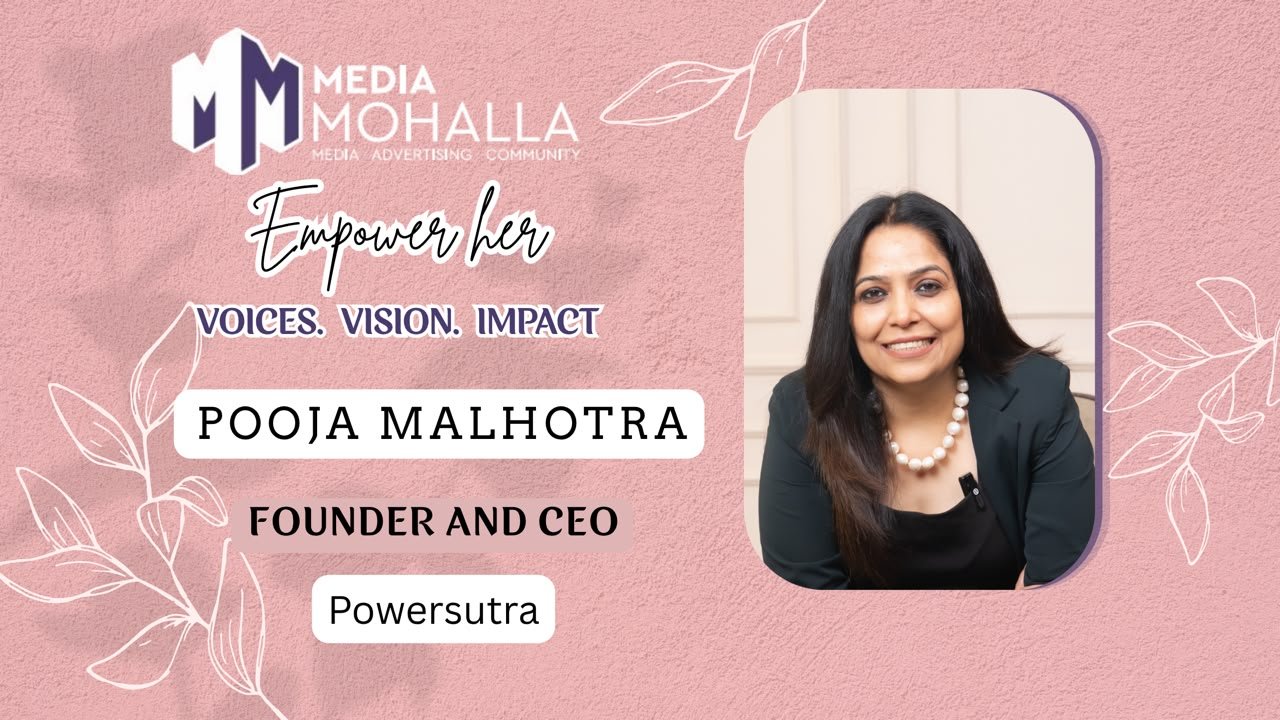
In the latest edition of Media Mohalla Empower Her Exclusive, we spoke with Pooja Malhotra, Founder of Powersutra, a women’s formal wear brand focused on empowering professionals through stylish, comfortable, and size-inclusive workwear.
Pooja transformed her vision into a successful fashion brand, inspiring countless women with her journey of resilience, leadership, and innovation. In this conversation, she shares her insights on entrepreneurship, overcoming challenges, and building a purpose-driven business.
1. What specific gap in women’s professional wear did you see in the Indian market that led you to build Powersutra?
The gap I saw was actually quite simple. Women were working in very different roles, industries and environments, but the clothing available to them was still very limited.You either had very basic formalwear that did not make you feel particularly confident, or fashionable pieces that looked good but were not really designed for a full working day.Fit was another big issue. The waist would fit but the hips wouldn’t. The shoulders would fit but the bust wouldn’t. Trousers could look great while standing but become uncomfortable the moment you sat down.I felt professional clothing should not be something a woman has to keep adjusting throughout her day.That was really the starting point of Powersutra. We wanted to create workwear that looks powerful, feels comfortable and actually understands a woman’s body.
2. Powersutra is built around the idea of making women feel confident and powerful through what they wear. How do you translate that philosophy into the design of every garment?
For me, confidence does not necessarily mean wearing something loud.Sometimes confidence is simply wearing a blazer and not thinking about it again for the next eight hours.You are not pulling the sleeves, checking whether the buttons are opening or adjusting your trousers every time you sit down. You just wear it and move on with your day.So when we design, we look at very practical things. How does the garment fall when you sit? Can you move your arms comfortably? Is the waist sitting correctly? How does the fabric behave after a few hours?Of course, the silhouette has to look sharp and polished. But if a woman looks powerful and does not feel comfortable, then for me the design is incomplete.The garment should support her confidence, not demand her attention.
3. Fit is one of the biggest challenges in women’s formalwear. How does Powersutra approach sizing, silhouettes and diverse Indian body types differently from conventional workwear brands?
One thing we understood very early was that you cannot simply take one garment, keep increasing the measurements and call that inclusive sizing.Bodies do not scale like that.When sizes change, proportions change too. Shoulders, bust, armholes, waist, hips and thighs all need different attention.Indian women also have incredibly diverse body structures, so one standard size chart can only tell you so much.We spend a lot of time looking at how a garment actually behaves on different bodies.Where is it pulling? Where is there extra fabric? Can she sit comfortably? Can she raise her arms? Does the blazer still hold its shape when it is buttoned?Customer feedback also plays a huge role in this.For us, inclusive sizing is not just about adding more sizes. It is about giving every size the same design attention and thought.
4. You come from a medical background rather than fashion. How has your experience as a doctor influenced the way you understand women, their needs and ultimately the products Powersutra creates?
Medicine taught me to observe before I try to solve a problem.Two people can come to you with what looks like the same issue, but the reason behind it can be completely different. You have to listen, understand the person and then find the right solution.I think I carried that mindset into Powersutra.When a woman says, “Blazers don’t suit me,” my first thought is not that blazers don’t suit her. I want to understand what she has experienced before.Was the shoulder wrong? Was the bust pulling? Was the length not right for her? Was she simply uncomfortable in it?Very often women start blaming their bodies for what is actually a garment problem.That is something I feel very strongly about.Your body is not supposed to fit into the clothes. The clothes should be designed to work for your body.
5. Powersutra is positioned around premium, functional workwear rather than fast fashion. How do you balance timeless design, quality and changing workplace fashion trends?
We definitely follow fashion, but we do not want to chase every trend.Workwear is different because you want to wear those pieces again and again. A blazer should not feel outdated after three months.So our starting point is usually a timeless silhouette. Then we bring freshness through colour, fabric, detailing and styling.I personally believe a good wardrobe should have pieces that you genuinely reach for repeatedly rather than things you wear once because they are trending.If you buy a Powersutra blazer today, I would like you to still feel confident wearing it two or three years from now.For us, staying relevant is important, but longevity is equally important.
6. What have your customers taught you about the modern Indian working woman that you couldn’t have learned through traditional market research?
Probably that women are much more practical about fashion than we sometimes assume.They notice everything.A customer might tell us, “I love the blazer, but the pocket needs to be slightly deeper because I keep my phone there.”Someone else might say, “The trousers are perfect when I am standing, but I need a little more room when I sit.”Those conversations teach you things that no spreadsheet really can.I have also realised that women no longer want to choose between looking good and being comfortable.She might have a client meeting in the morning, spend the afternoon at her desk and go somewhere straight after work.She wants a wardrobe that can move with her life.Our customers have taught us that modern workwear is not only about dressing for an office anymore. It is about dressing for the woman’s entire day.
7. Women’s workplaces are becoming more fluid, with hybrid work, leadership roles and changing corporate cultures. How is Powersutra redefining what a “power wardrobe” looks like today?
I think the idea of power dressing has changed completely.Earlier, when you thought of power dressing, you imagined a very rigid corporate uniform. A dark blazer, formal shirt and trousers.Today it can look very different.It can be a beautifully tailored pantsuit. It can be a relaxed blazer with a camisole. It can be a structured co ord or even a simple monochrome look.Women are working from offices, cafés, airports, homes and boardrooms, sometimes all within the same week.So a power wardrobe today has to be versatile.For me, if you put something on and immediately feel more composed, more confident and ready for the room you are walking into, that is power dressing.
8. As Powersutra grows, how do you maintain the personal understanding of fit and customer experience that helped build the brand in its early days?
This is something I think about a lot because growth can easily create distance between a brand and its customer.In the beginning, you hear almost everything directly. As the business grows, naturally there are more teams and more layers.So we consciously try to keep customer feedback very close to the product team.Reviews, returns, sizing concerns and conversations on social media are not just customer service issues for us. They are product information.If multiple women are telling us the same thing, we need to listen.I never want Powersutra to become a brand that says, “This is our size chart, adjust yourself accordingly.”We should always be asking what we can improve from our side.That mindset has to remain even as the company grows.
9. The Indian fashion market is crowded with D2C and fast-fashion players. What is the one thing Powersutra believes it can own in the women’s workwear space?
If I had to choose one thing, I would say fit led power dressing for Indian women.There will always be brands that are faster than us or have thousands of styles.I do not think we need to compete on that.I would much rather a woman think of Powersutra when she has something important coming up.It could be an interview, a presentation, her first leadership role or an important meeting.I want her to think, “I know I will find something there that makes me feel confident and put together.”If we can build that kind of trust, that is far more valuable to us than simply having more products.
10. Looking ahead, do you see Powersutra primarily as a women’s formalwear brand, or do you envision building a much larger lifestyle brand around the idea of confidence and empowerment?
Workwear is definitely our foundation, but the idea behind Powersutra has always been bigger than a blazer or a pair of trousers.The bigger idea is confidence.Clothing is simply where we started because what you wear can genuinely change how you carry yourself.So yes, over time I can see Powersutra growing into a larger ecosystem around the modern working woman.But I also do not want us to expand just for the sake of becoming bigger.Whatever we do has to make sense for the woman we are building for.The question we will continue asking ourselves is very simple.Does this genuinely help her feel more confident, capable and comfortable in the life she is building?