

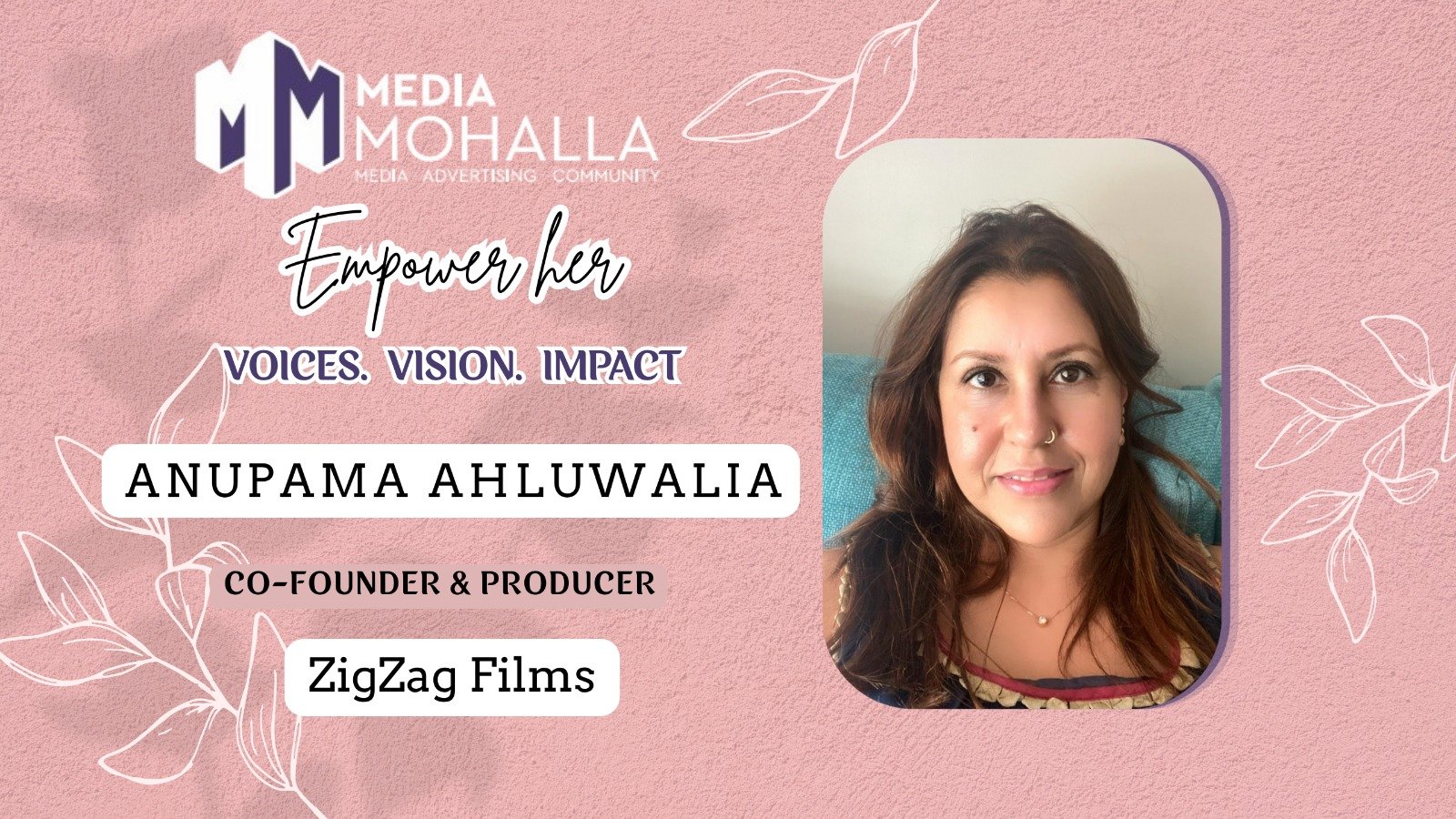
In our latest edition of Media Mohalla – Empower Her, we feature Anupama Ahluwalia, Co-Founder and Producer at ZigZag Films, a Mumbai-based production house known for creating some of India’s most loved and culturally relevant advertising campaigns.
Since co-founding ZigZag Films in 2018, Anupama has played a key role in building the company into a trusted name in the industry, leading production, business operations, and strategic partnerships. Having worked with leading brands such as PhonePe, Swiggy, Myntra, Flipkart, Samsung, Tata, and MakeMyTrip, she continues to champion storytelling that is authentic, relatable, and impactful.
In this conversation, Anupama shares her journey, leadership insights, and the lessons she has learned while building a successful production company from the ground up.
1. Advertising often celebrates the creative idea, but far less attention is paid to the business that brings those ideas to life. What does “making creativity possible” actually mean to you?
I’ve never really seen production as the stage where creativity ends. If anything, it’s where an idea is tested.A script can look wonderful on paper, but bringing it to life requires hundreds of decisions that most people never see. It’s about assembling the right team, creating an environment where directors and agencies can do their best work, solving problems without losing sight of the original idea, and sometimes simply ensuring everyone feels supported enough to do what they do best.For me, making creativity possible has always meant enabling rather than controlling. Good production isn’t about drawing attention to itself. It’s about making the process seamless so the creative idea remains at the centre.At ZigZag, we’ve always believed the best work comes from partnership. When everyone trusts one another and feels heard, there’s room to experiment, adapt and push ideas further. If we’ve done our job well, the audience remembers the story, not the challenges it took to get there.
2. Building a production company requires balancing creative ambition with commercial realities. How have you learned to make decisions that protect both?
One of the biggest lessons I’ve learnt is that creativity and commercial discipline don’t have to be at odds. In fact, one often makes the other stronger.Every project brings its own realities, budgets, timelines, and expectations, but I’ve never believed they should limit creative thinking. More often than not, they push you to think differently.What has helped us over the years is bringing production into the conversation early. When producers are involved from the start, you’re not simply reacting to constraints later; you’re helping to shape solutions that still honour the idea.We’ve also learnt that not every opportunity is worth pursuing if it comes at the expense of quality or the team’s wellbeing. Sustainable businesses aren’t built by saying yes to everything. They’re built by being thoughtful about what you take on and by ensuring you can give every project the attention it deserves.
3. The success of a campaign is often judged in minutes on screen, but months of planning happen behind the scenes. What are the invisible decisions audiences never get to see?
People see the final film, but they don’t see everything that goes into making those few minutes feel effortless.Some of the biggest decisions are made long before a shoot begins. Finding a location that supports the story, bringing together the right crew, planning schedules that allow people to do their best work- those decisions shape the outcome as much as anything that happens on set.And then, of course, there’s Murphy, who’s practically an unofficial member of every production team J. If something unexpected can happen, it usually does. Weather changes, equipment decides to have a bad day, a location falls through, or a schedule suddenly needs rewriting. A large part of production is quietly navigating those moments without derailing the creative vision.That’s probably why good production often goes unnoticed. If everything feels seamless on screen, it usually means a lot of careful planning, quick thinking, and teamwork went on behind the scenes.
4. You’ve worked across agencies, directors, brands and production teams. What have you learned about building trust between so many stakeholders with different priorities?
I’ve realised that everyone comes to a project wanting the same thing: a good piece of work. They may have different responsibilities, but the intention is usually shared.In my experience, trust comes from being transparent and consistent. If something is going well, we communicate it. If something needs to change, we have that conversation early instead of waiting for it to become a bigger issue.It’s also important to listen. Directors, agencies, clients and production teams all bring different perspectives, and some of the best solutions emerge from those conversations rather than from one person having all the answers.Over the years, many of our strongest relationships have been built project by project. People come back because they know we’ll be honest, collaborative and equally invested in the outcome.
5. In production, things rarely go exactly as planned. How do you create an organisation that stays calm and solutions-oriented under pressure?
Production teaches you very early that, no matter how well you plan, something unexpected will happen. That’s simply part of the process.What matters is how the team responds.We’ve tried to build a culture where people don’t waste time looking for someone to blame. Instead, they focus on finding the next best solution. That mindset only develops when people feel supported and know they’re trusted to make decisions.Preparation is important, of course, but so is experience. When you’ve worked together over time, a quiet confidence develops within the team. People know they can rely on one another.I think leadership also plays a role. Teams often take their cue from leaders’ responses. Staying calm doesn’t mean ignoring challenges; it means creating enough confidence for people to think clearly and move forward together.
6. As a founder, how has your definition of leadership evolved from your early days at ZigZag Films to where the company is today?
In the early days, I probably thought leadership meant having the answers.Over time, I’ve realised it’s much more about creating an environment where other people can do their best work.As ZigZag has grown, my role has shifted from managing every detail to building the right team, trusting them and giving them space to take ownership. That doesn’t mean stepping away; it means knowing when to guide and when to let people lead.I’ve also learnt that culture isn’t built on big moments. It’s built through everyday interactions, the way you treat people, how you respond when things don’t go as planned, and the consistency with which you show up.
7. Production has traditionally been seen as an execution function. Do you think that perception is changing, and why should production be viewed as a strategic creative partner?
I do think that perception is changing because the complexity of filmmaking has changed.Today, production is involved much earlier in the process. We’re not just executing an idea; we’re helping to find the best way to bring it to life. That could mean suggesting a different approach, identifying opportunities to strengthen the storytelling, or solving practical challenges before they force creative compromises.When production is part of the conversation from the outset, everyone benefits. Agencies, directors, clients and production teams become collaborators rather than working in silos.The best projects I’ve been part of have always felt like partnerships.
8. Technology is changing every part of filmmaking, from pre-production to post. Which changes excite you, and which aspects of filmmaking should always remain human?
Technology has opened up incredible possibilities across filmmaking, from planning and pre-visualisation to post-production. It allows us to work smarter, solve challenges faster and often push ideas further than we could before.What excites me most is that it gives creative teams more ways to enhance an idea rather than simply execute it. If technology helps a story become richer, more immersive or more emotionally engaging, then it’s doing exactly what it should.But the starting point still has to be the idea itself. Great films are built on observation, emotion and human experiences. Technology can amplify those things, but it can’t replace them.
9. Many conversations around creativity focus on directors and agencies. What role do producers play in protecting the integrity of an idea?
A producer’s job is to protect the idea from the moment it enters production.That doesn’t always mean saying yes to everything. Sometimes it means asking difficult questions, finding better ways to execute it, or ensuring that practical realities don’t slowly dilute what made the idea exciting in the first place.Good producers are constantly balancing creativity with execution, and when that balance works well, the audience never notices.They simply experience a film that feels true to its original intent.
10. You’ve built ZigZag Films during a period when advertising itself has evolved dramatically. What has remained constant despite all the industry changes?
Formats have changed, audiences have changed, and technology has changed.What hasn’t changed is that people still respond to stories that feel honest and relatable.We’ve always enjoyed working on films that are rooted in everyday observations because those are the stories people recognise immediately, regardless of where they’re watching them.The platforms may evolve, but authenticity still travels.
11. What kind of culture were you intentional about creating at ZigZag Films, and why was that as important as building a successful business?
From the beginning, we wanted ZigZag to feel like a place people wanted to come back to; not just because of the work, but because of the experience of working together.Film sets can be intense, and deadlines don’t wait for anyone. But we’ve always believed you can be efficient without creating unnecessary pressure. We try to build an environment where people feel respected, heard and comfortable speaking up, regardless of their designation.Respect is non-negotiable for us. Everyone on set deserves the same respect, whether they’re leading the project or supporting it behind the scenes.We also don’t take ourselves too seriously. We enjoy the process, celebrate the small wins and try to keep a sense of humour alive, even on the busiest days. I think when people feel relaxed and valued, they collaborate better, and that ultimately reflects in the work.
12. Many women entering creative industries aspire to leadership roles. Beyond advice, what practical lessons from building your own company have shaped the way you lead?
One thing I’ve learnt is that confidence grows through experience, not beforehand.There will always be moments when you feel uncertain, especially when you’re building something from scratch. I’ve found that showing up consistently, being prepared, and staying open to learning matter far more than trying to appear as if you have everything figured out.I’ve also learnt the importance of building strong teams. Leadership isn’t about doing everything yourself; it’s about trusting people and creating opportunities for them to grow alongside you.
13. Looking back, what has been the biggest misconception you’ve encountered about running a production company?
That production is only about logistics.People often see the visible side of filmmaking- the shoot itself- but don’t always realise how much creative thinking, planning and relationship-building happens before that.A production company isn’t simply coordinating people and schedules. It’s helping to create the conditions in which ideas can become their best versions.
14. How do you know when to say ‘yes’ to an opportunity and when protecting your team’s time or creative standards matters more?
Every project begins with an idea, and I think we have a responsibility to protect it.Before saying yes, we ask ourselves a few simple questions. Do we have the time to nurture this idea? Is the budget aligned with its ambition? Can we assemble the right people to bring it to life without compromising what makes it special? If the answer is yes, we know we can add value.At the same time, there are ideas that are simply too good to walk away from. Sometimes they come with tighter budgets, impossible timelines or executional challenges that look daunting on paper. If we genuinely believe in the idea, and especially if it’s for a brand or creative partner we’ve built a relationship with, we’re often happy to step outside our comfort zone and treat it as a challenge worth solving. Some of our most rewarding projects have come from exactly those situations.But that decision always comes from the same place: believing we can do justice to the work. The best partnerships aren’t built by saying yes to everything. They’re built on being honest about where you can truly make a difference, and giving every idea the care it deserves.