

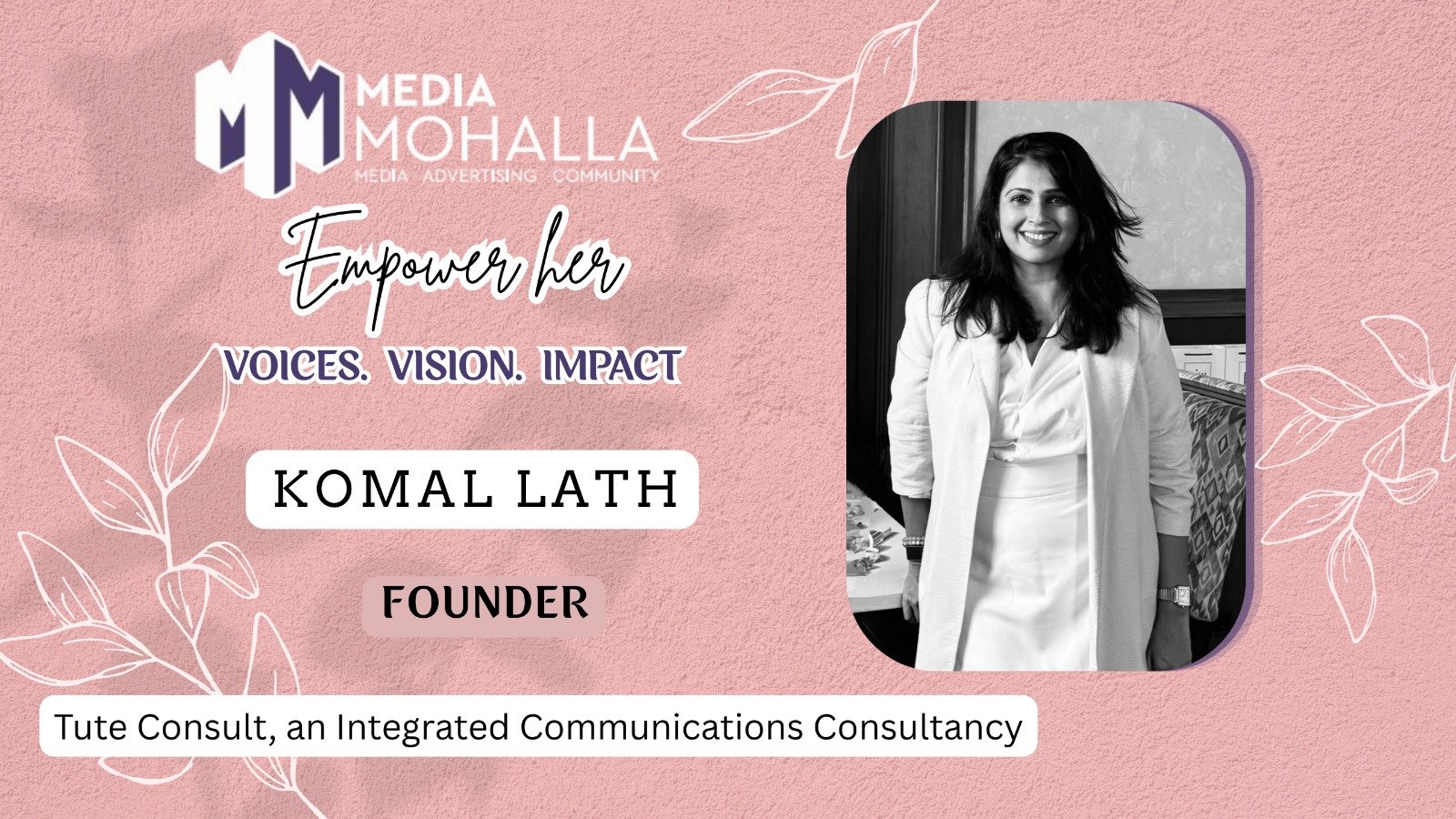
In our exclusive engagement with Komal Lath, Founder of Tute Consult, an Integrated Communication Consultancy for Media Mohalla EmpowerHer Exclusives, we spotlight a visionary leader who is redefining strategic consulting through innovation, purpose, and people-centric leadership.
With a strong focus on business transformation, organizational growth, and leadership development, Komal Lath has built Tute Consult into a trusted partner for businesses navigating change and scaling sustainably. Her expertise in crafting impactful strategies, fostering high-performing teams, and driving meaningful business outcomes has earned her recognition as a dynamic entrepreneur and change-maker. In this exclusive conversation, Komal shares her entrepreneurial journey, leadership philosophy, and insights into building resilient organizations in an ever-evolving business landscape.
1. Tute Consult has grown by blending PR, influencer marketing, content, and brand strategy under one roof. In today’s fragmented media landscape, what separates a communications partner from a traditional PR agency?
The distinction is fundamental. A traditional PR agency chases the press release and outcome based metric. A communications partner drives business strategy. Too many clients still treat PR as an announcement-only game. They wait for the product launch, the funding round, or the crisis, push it out, then fall silent. That’s not communications; that’s tactical firefighting.What separates us is ruthless integration. We’ve stopped operating in silos where PR handles media, digital handles social, and influencers are an afterthought. At Tute, every channel works in concert. We ask a different question: How does a brand build relentless visibility and credibility across multiple touchpoints simultaneously?A communications partner operates within the business context. We deep dive into your P&L, your market position, your competitive threats. We understand India’s complexity – multi-languages, distinct consumer economies, and a billion mobile-first users. We combine research and insights with Vector, integrated media relationships, and our creator network to move the needle on actual business outcomes.The biggest difference comes down to accountability. We don’t just deliver media placements or engagement metrics. We partner on strategy alignment, transparent budgets, clearly defined hours, and measurable business impact. When creativity serves business goals, that’s when magic happens.
2. You have worked with both legacy brands and fast-growing D2C businesses. How does the communication strategy differ when you’re building a brand from scratch versus reinventing an established one?
These are entirely different challenges that require opposite mindsets. When you’re launching a brand, you have a unique advantage: you’re writing the first chapter on a blank slate. There’s no baggage, no legacy narratives to overcome, no comparisons being drawn. Your focus is on establishing category authority, credibility, and market positioning from day one. You’re racing against time to create category differentiation before competitors define the space – very similar to what we did with say a brand like Minimalist.With legacy brands, the challenge is archaeology. What made them credible yesterday might make them irrelevant today. Reinvention requires unraveling what’s core to their identity versus what’s dated. We’ve worked with brands that had 30 years of equity but were completely invisible to digital-first consumers. The strategy shifts from ‘Let me tell you about our heritage’ to ‘Let me show you why we matter now.’For D2C brands, the playbook is velocity and community. They need visibility fast because their margins depend on scale and word-of-mouth. We build multi-channel momentum through PR, influencer partnerships, content series, and niche community conversations. It’s relentless weekly wins, not waiting for the next big product announcement.For legacy brands, it’s the opposite. It’s about strategic reset. We reconstruct their narrative for new audiences, leverage their strengths as proof points, and rebuild credibility with new consumer segments. The reinvention strategy might take 18-24 months because you’re fighting years of marketplace perception.The real skill is reading the market opportunity and the brand’s appetite for change. Some legacy brands want cosmetic updates. Others need fundamental repositioning. Get that diagnosis wrong and your entire strategy fails. The channels of communication have also multiplied – it’s digital first with culture and creativity at the heart of it!
3. You have often advocated that PR should be viewed as a business management function rather than merely a marketing tool. What organisational shift is needed for communication leaders to earn a seat at the decision-making table?
This is about reframing the function entirely. Communications leaders need to stop thinking like marketers and start thinking like operators. If you’re only concerned with media coverage, you’ll never be strategic. If you understand business risk, market dynamics, competitive threats, and revenue impact, you become indispensable.
The organisational shift requires three things.
- First, communications leaders must demand a seat in board strategy conversations before decisions are made, not after. You should be in the room when product launches are planned, when pricing is set, when market entry strategies are finalized. Not to approve the campaign later, but to shape the go-to-market reality. Your job is to flag market perception risks and execution challenges that others miss.
- Second, you need to speak the language of business impact. Stop counting media placements. Start tracking brand health, market share movement, customer acquisition cost, and revenue attribution. When your communications strategy directly moves the needle on what the CFO cares about, that’s when you earn credibility at the table. This was one of the fundamental reasons we started Vector – to understand where you are and where you desire to be.
- Third, you must invest in business acumen. Understand your company’s unit economics, customer lifetime value, competitive positioning. Read quarterly results. Know the industry. This isn’t marketing education anymore; it’s business education with a communications lens.
The biggest barrier I see is that many communication leaders haven’t upgraded their thinking. They’re still defensive about the PR function rather than proactive about business outcomes. You can’t earn a seat at the table if you haven’t done the work to understand what matters at the table.
At Tute, we partner with clients on business strategy, not just communication execution. That’s what builds the relationship and the impact.
4. The influencer ecosystem has evolved from celebrity endorsements to community-led storytelling. What metrics do you believe truly define a successful influencer collaboration beyond reach and engagement?
Reach and engagement are vanity metrics. I reject them entirely. When clients ask for ’30 coverages’ or massive follower counts, we push back. That’s not business impact; that’s brag value which may be empty.
Real influencer success is defined by four things.
- First, audience relevance and trust. Does your creator actually have influence over the decision-making of your target customer? I’ve seen brands work with 500K follower creators and see zero conversion. I’ve seen nano-creators with 5K highly engaged followers drive meaningful business. The question isn’t how many people see the content; it’s how many people the creator can move to action.
- Second, authentic alignment. This is where most brands fail catastrophically. Creators are communities. They have built trust with their followers based on specific values and authenticity. When you drop a campaign that contradicts their worldview, audiences detect the inauthenticity immediately. The collaboration needs to feel organic to the creator’s voice and the brand’s positioning.
- Third, measurable business impact. What changed because of the influencer partnership? Did awareness move in target segments? Did consideration lift? Did sales accelerate? Did customer acquisition cost improve? These are the metrics that matter. If the campaign ended and nothing shifted, it wasn’t successful.
- Fourth, long-term relationship value. One-off transactions feel transactional to audiences. The most powerful influencer strategies build sustained narratives over time. A creator talking about your brand monthly for six months creates different impact than a single campaign blitz. You’re building market momentum, not chasing viral moments.
The biggest mistake brands make is treating influencers like billboards. They’re storytellers. If you don’t give them genuine creative freedom and authentic product beliefs, the collaboration will feel forced. And audiences can smell forced from a mile away.
5. Brand authenticity has become a competitive advantage. How do you ensure that every campaign Tute Consult delivers reflects a brand’s core purpose instead of simply following market trends?
This is the conversation we have before we take on a client. I’ll be direct: if the brand’s stated purpose doesn’t align with its actual operations, we walk. We’ve turned down clients because they wanted us to sell a story that didn’t match reality. That’s not strategy; that’s lying at scale. Authenticity begins with diagnosis. We spend time understanding what the brand actually stands for, not what it wishes it stood for. Talk to employees. Look at how they allocate resources. See which customers they truly prioritize. Sometimes the brand’s purpose isn’t in the mission statement; it’s in the business model.Once we understand the real north star, every creative and strategic choice flows from that. When we built campaigns for Minimalist, we weren’t following the clean beauty trend. We were reinforcing the specific philosophy behind the brand. That foundation allowed every piece of communication to feel authentic because it wasn’t invented for the campaign; it was already embedded in the brand.The hardest part is resisting trend-chasing pressure. Every quarter, there’s a new social media trend, a new consumer behavior, a new platform opportunity. Brands want to chase every shiny object. Our job is to redirect that energy back to core purpose.I tell clients: ‘That trend is exciting, but does it serve your purpose? If yes, we’ll be earlier and more credible than competitors. If no, we skip it and build something aligned with who you actually are.’ Brands that follow trends sound like everyone else. Brands that are rooted in authentic purpose become category leaders.The long-term advantage is sustainable differentiation. Trends change every season. The purpose is durable. When you anchor everything in real brand purpose, you’re building something that lasts.
6. As a woman entrepreneur leading an independent communications consultancy in a highly competitive industry, what were the biggest credibility barriers you faced in the early years, and how did you overcome them?
- In the early years, I have had clients ask if the founder was male or did i have a male co-founder. The communications industry has a credibility bias. Big networks with established names and male leadership were trusted. An independent woman-led consultancy had to prove itself differently. Things are of course vastly different now.
- The second barrier was explanation. Nobody understood what Tute Consult was. Was it PR? Was it advertising? How does it differ from the big agencies? I yet see myself repeating that we are an integrated brand-focused consultancy.
- The third barrier was resource constraints. I didn’t have a war chest for business development. We built through relationships and results. That meant working harder and delivering better than bigger agencies with more resources.
Some things that helped me overcome:
- First, I stopped trying to fit into existing category definitions. Instead of saying ‘We do PR,’ I started articulating what we actually do: We’re a strategic communications partner that moves business metrics. That clarity attracted clients who valued substance over brand names.
- Second, I became visible. I wrote about communications strategy. I spoke at industry events. I invested in being quoted and recognized as a strategic thinker, not just an agency owner. Credibility comes from being recognized as someone who understands the industry better than competitors.
- Third, I built a portfolio of work that spoke louder than credentials. Our early clients became advocates. Word of mouth from someone who had actually worked with us was worth more than any amount of advertising spend. I prioritized doing remarkable work for clients willing to take a chance on us.
- Fourth, I stopped apologizing for being independent. I made that a strength. We don’t have the might of big networks. We don’t have account managers whose goal is to maximize billable hours. We’re directly accountable to outcomes. That became a competitive advantage.
The honest truth is that being a woman entrepreneur meant I had to be better, more prepared, and more strategic. I had less margin for mediocrity. That pressure forced me to stay sharp and always deliver on promises.
7. With AI transforming content creation, media monitoring, and reputation management, where do you see human creativity becoming even more valuable in the communications industry over the next five years?
AI is a tool. It’s not a threat if you understand its limitations.AI will dominate the mechanical and grunt work. Content distribution optimization, media monitoring, data analysis, trend spotting, audience segmentation, even first-draft content creation. These are areas where machine learning will become standard because AI is faster, more scalable, and more consistent than humans.Here’s where human creativity becomes invaluable – AI can generate ideas, but it generates them based on patterns it has already learned. True strategic creativity comes from seeing gaps in the market that don’t exist yet. It comes from spotting consumer needs before they’re obvious. That requires human intuition, curiosity, and the ability to connect unrelated dots.
- The second area is editorial judgment. AI can identify what’s trending. Humans understand what’s meaningful. These are different. A trend might be viral; it might also be fundamentally misaligned with a brand’s purpose. A human strategist makes that call. The person who says ‘No, we’re skipping this trend because it contradicts our positioning’ is making an editorial judgment that machines can’t make.
- The third area is narrative architecture. AI can write copy. It will struggle to craft coherent brand narratives that resonate at emotional and strategic levels simultaneously. The ability to weave research insights, brand purpose, market dynamics, and human truth into a compelling story is uniquely human.
In five years, the communications landscape will be split into two camps. There will be volume players who use AI to produce cheap, scalable content optimized for reach. They’ll struggle with differentiation because everyone will have access to the same tools.The other camp will be strategic partners who use AI as an accelerant for human thinking. They’ll use machine learning to clear away the mundane work, freeing teams to think deeply about strategy, purpose, and impact.The winners will be the humans who become fluent in AI, who understand its capabilities and its blind spots. If you can use AI to amplify human creativity rather than replace it, you’ll be irreplaceable.
8. EmpowerHer celebrates women who inspire through action. Looking back at your entrepreneurial journey, what advice would you give to women who want to build service-based businesses that create both commercial success and lasting impact?
- The first piece of advice is stop waiting for permission. You don’t need the perfect plan, the ideal funding, or the right connections to start. I started Tute Consult based on notes I scribbled on tissues over pizza with friends. The initial eureka was easy; what followed was pure grit.
- Second, understand your market deeply before you build your business model. I spent years in PR and communications before I started Tute. That immersion taught me where the gaps were. We weren’t solving problems that didn’t exist. We were solving problems I had actually experienced. That depth of understanding is your unfair advantage.
- Third, clarity beats scale initially. You don’t need to be everything to everyone. We’re ruthlessly integrated but highly specialized. We work with legacy, startups, and founders in specific sectors where we have deep expertise. That clarity allowed us to build credibility faster than if we had tried to serve every possible client.
- Fourth, invest in people and relationships relentlessly. A service business is ultimately a people business. The best talent wants to work somewhere with clarity of purpose, psychological safety, and genuine growth opportunity. We’ve been intentional about building a culture where people can explore ideas without inhibitions. That culture compounds over time.
- Fifth, charge what you’re worth. Underpricing your services doesn’t attract better clients; it attracts clients who don’t value what you do. If you’re solving real business problems, you deserve to be compensated accordingly. This took me years to internalize, but it’s critical.
- Sixth, make transparency non-negotiable. In client relationships, be radically honest about what’s working, what’s not, what you know, and what you don’t know. I’ve had clients walk because we told them something uncomfortable. I’ve also had clients become partners for life because we earned their trust through honesty. Trust is built slowly and lost quickly.
Finally, remember that impact isn’t about size; it’s about significance. Building a service business means you can influence the success of multiple brands, multiple teams, multiple founders. The cascade of impact can be extraordinary if you’re focused on meaningful work rather than just revenue growth.The harder truth is that building a service business requires you to always be on. You can’t hide behind a product or a supply chain. You are the business. That means investing in your own growth, your own thinking, your own network continuously. If you’re not willing to be a perpetual learner and someone who can articulate your value clearly, don’t start a service business.But if you’re willing to do the work, build something real, and stay true to your convictions, service businesses offer something unique: direct impact on meaningful outcomes. That’s a privilege I don’t take lightly.