

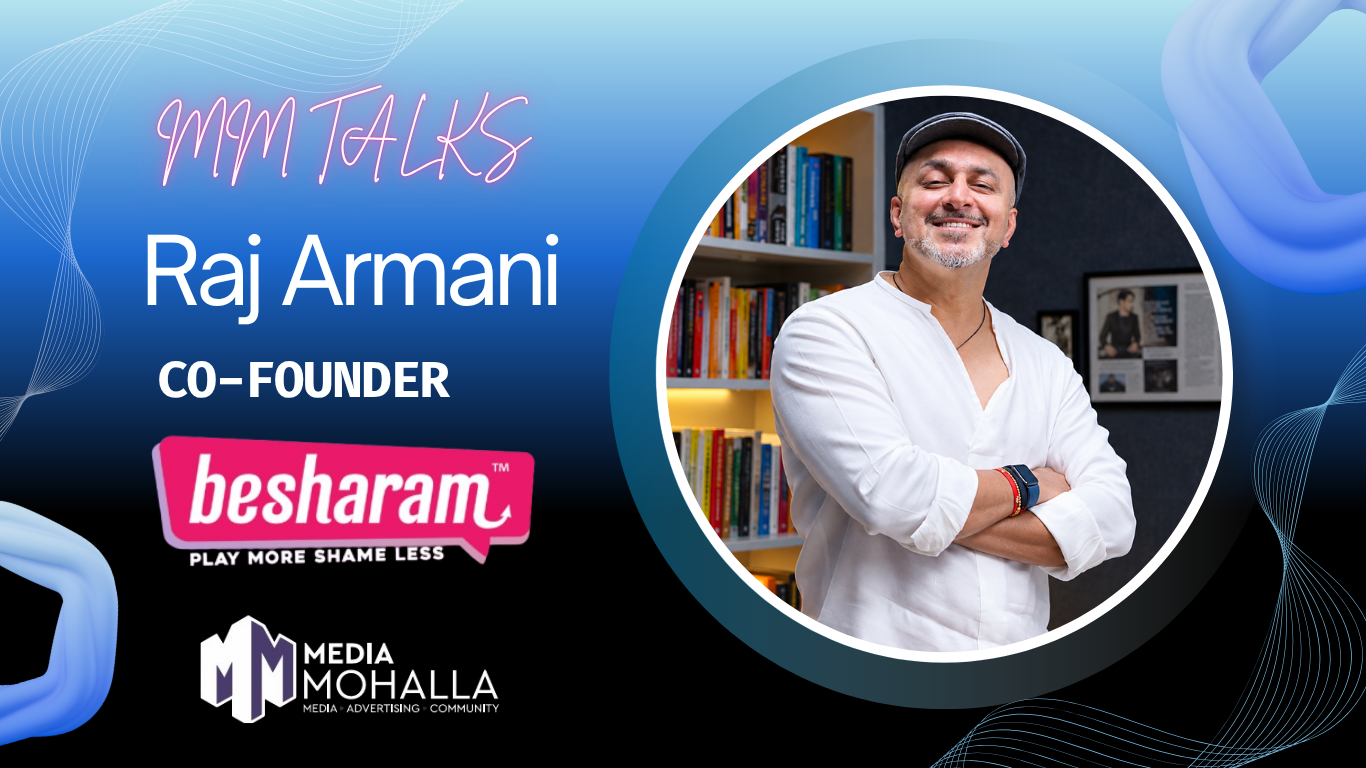
In the latest edition of Media Mohalla’s MM Talks, we speak with Raj Armani, Co-Founder of IMBesharam.
IMBesharam, one of India’s pioneering sexual wellness platforms. An immigrant entrepreneur with experience spanning multiple markets, Raj has been at the forefront of challenging conventions and reshaping conversations around sexual wellness in India.
In this candid conversation with Media Mohalla, Raj shares his entrepreneurial journey, the story behind building IMBesharam, the evolution of India’s sexual wellness landscape, changing consumer attitudes, and what it takes to build a brand in a category that continues to navigate cultural perceptions and social taboos.
1. You’ve built businesses across hospitality, telecom, retail, and e-commerce – what inspired you to eventually enter one of India’s most unconventional and taboo-driven industries with IMBesharam?
I’ve always been attracted to businesses where there is a clear gap between what people want and what the market is actually giving them.
Before IMBesharam, I had businesses across hospitality, telecom and retail. Those were much more conventional industries. But around 2012–13, when we started looking closely at India, sexual wellness was a fascinating contradiction. India had a huge young population, rapidly growing internet access and increasingly global exposure – but when it came to conversations around sex and pleasure, we were still extraordinarily uncomfortable.
The demand existed. The conversation didn’t.
What struck me even more was how difficult the customer experience was. If somebody wanted to buy an intimacy product, where would they go? There was very little reliable information, limited access to reputable international brands, concerns about privacy and authenticity, and tremendous embarrassment associated with simply walking into a store and asking questions.
That looked like a business opportunity, but it also looked like an opportunity to change something culturally.
When we started IMBesharam 13 years ago, the objective was never simply to sell sex toys. We wanted to normalize pleasure and democratize access to sexual wellness. That meant giving people access to good products, education and information while creating an environment where they didn’t feel judged for being curious about their own bodies or relationships.
In some ways, the fact that the category was considered unconventional made it more interesting to me. If everybody already understands a market and everybody is comfortable entering it, you’re probably not creating a category – you’re competing in one.
With IMBesharam, we had the opportunity to help build the category itself.
2. Launching a sexual wellness platform in India over a decade ago came with cultural resistance and legal scrutiny. What were the toughest early-stage battles that tested your entrepreneurial conviction?
When we started 13 years ago, almost everything was a battle — and honestly, selling the product was sometimes the easiest part.
The bigger challenge was building an entire ecosystem around a category that many mainstream businesses didn’t want to touch. Payment gateways were hesitant to work with us. Advertising platforms had restrictions. Social media platforms frequently rejected content. Finding logistics, banking and other partners who understood the category wasn’t easy. Even recruiting was difficult – it took us nearly two years to hire our first female employee because of the stigma associated with working for a sexual wellness company.
Then there was the customer side. People were curious, but they were also worried: Is this legal? Will the packaging reveal what’s inside? Will my family find out? Is my information private? Those weren’t occasional questions – they were fundamental barriers to purchase.
So we realized very early that we weren’t simply building an e-commerce company. We were building trust infrastructure around a taboo category.
That meant discreet packaging, customer privacy, authentic products, education and an enormous amount of attention to how we communicated. We had to make someone feel comfortable buying something they might never have been comfortable asking for in a physical store.
There were certainly moments when it would have been easier to walk away. But the demand kept telling us something important: the consumer wasn’t the problem. People wanted these products and wanted reliable information about sexual wellness. The infrastructure and social acceptance simply hadn’t caught up with them yet.
That distinction gave us conviction.
Thirteen years later, when we have delivered more than a million orders and see women representing roughly half of our customer base – and more than half of our team – it’s remarkable to think about how different those early days were.
The biggest lesson for me was that when you’re creating a new category, resistance isn’t necessarily evidence that you’re wrong. Sometimes it’s evidence that you’re early.
3. IMBesharam positioned itself not just as an e-commerce company but as a social conversation starter. How did you balance commercial growth with the responsibility of changing societal perceptions around intimacy and wellness?
For us, the two were never really separate.
You can’t build a sustainable sexual wellness business in a society where people are made to feel ashamed for wanting the products you sell. So if we wanted the category to grow, we also had to help change the conversation around it.
That’s really where “Play More, Shame Less” came from. It wasn’t created simply as a catchy tagline. It represented what we wanted the brand to stand for – pleasure is normal, curiosity is normal, and adults shouldn’t have to carry shame around something that is such a natural part of being human.
Of course, we’re a business and we need to sell products. But sometimes changing the conversation means talking about things that don’t immediately result in a transaction. We’ve invested heavily in educational content, conversations with doctors and experts, media discussions, social content and collaborations that make intimacy easier to talk about.
And we’ve always tried to use humor. India is already uncomfortable enough talking about sex – we didn’t want to make the conversation even heavier. Sometimes making someone laugh is the easiest way to get them to lower their guard and start talking.
What’s interesting is that we’ve been able to watch the cultural shift through our own business. In our early years, roughly 70% of our customers were men. Over time, women have grown to roughly half of our customer base. We’re seeing demand coming from Tier 2 and Tier 3 cities, couples shopping together, people in their 40s and 50s buying their first products, and conversations happening publicly today that would have been extremely difficult when we started.
Our community across social and digital platforms is now more than 500,000 people. To me, that community is just as important as the number of products we’ve sold, because it represents people choosing to engage with the conversation.
So I don’t see social change and commercial growth as competing objectives. In our category, they’re actually connected. Every time the shame reduces a little, the market expands a little.
And perhaps that’s the simplest way to explain what we’ve been trying to do for the last 13 years: we sell products, but what we’re really trying to remove is shame.
4. Before building a disruptive online brand, you were already running successful ventures in telecom and hospitality. Which lessons from those traditional businesses helped you scale a bold digital-first startup?
The industries may look completely different, but the fundamentals of business really don’t change that much.
Hospitality taught me that the experience is the product. A customer may forget what you told them, but they rarely forget how you made them feel. That became incredibly important with IMBesharam because we were operating in a category where customers were already nervous before they even reached our website.
Telecom and retail taught me something different – scale is built through systems. Inventory, margins, vendor relationships, customer service, logistics and cash flow may not be the glamorous side of entrepreneurship, but they’re what ultimately determine whether a business survives.
Those lessons became even more important when we moved into e-commerce.
You can have a brilliant website and fantastic marketing, but if the product isn’t available, the package doesn’t arrive on time, customer service doesn’t respond, or the economics don’t work, you don’t really have a scalable business.
Another lesson I carried with me was the importance of listening to the customer rather than assuming you know what they want.
We’ve seen that repeatedly at IMBesharam. Sometimes the products we thought would become huge weren’t the winners, while something relatively simple would sell out again and again. The market has a wonderful way of humbling entrepreneurs.
And perhaps the biggest lesson was resilience.
In traditional businesses, you’re usually competing within an established system. With IMBesharam, we often had to build the system while simultaneously building the company. There wasn’t really a playbook for creating a large sexual wellness platform in India.
So while people may see IMBesharam as a bold or disruptive idea, behind that disruption are actually some very traditional business principles: understand your customer, protect your cash flow, build strong systems, deliver consistently and earn trust one transaction at a time.
Technology changes. Industries change. Consumer behaviour changes. The fundamentals of building a good business don’t.
5. Your journey reflects a strong ability to identify underserved markets before they become mainstream. What do you personally look for when evaluating whether a “controversial” idea can become a scalable business opportunity?
I don’t necessarily look for controversial ideas. I look for unmet demand – and sometimes the reason that demand is underserved is because everyone else is uncomfortable going after it.
There is an important difference.
When I evaluate an opportunity, one of the first questions I ask is: Is there a real consumer problem here, or are we just fascinated by the idea? Entrepreneurs can sometimes fall in love with disruption for the sake of disruption. But controversy doesn’t create a business. Customers do.
With IMBesharam, the signals were very clear. People wanted sexual wellness products. They were searching for them, trying to find reputable brands and looking for information – but the market wasn’t serving them properly. The friction wasn’t a lack of demand; it was access, privacy, trust, education and social stigma.
That’s an interesting place to build a business because if you can remove those barriers, you’re not necessarily creating demand from scratch. You’re unlocking demand that already exists.
The second thing I look at is whether the market can become significantly larger if attitudes, technology or access change. What looks niche today can become mainstream surprisingly quickly when the underlying consumer behaviour is already moving in that direction.
And finally, I ask whether we can build something defensible around it. Being first is exciting, but being first doesn’t mean very much if you can’t build trust, distribution, brand recognition, supplier relationships, operational capability and a community around the business.
I also think entrepreneurs need to become comfortable with being misunderstood for a while. If you’re entering an underserved category early enough, there may not be much external validation telling you that you’re right.
But you have to distinguish between people rejecting your idea and customers rejecting your product. Those are two very different signals.
If society is uncomfortable but the customer keeps showing up, I pay attention to the customer.
So my formula is actually fairly simple: find genuine demand, identify the friction preventing that demand from being served, and determine whether you can remove that friction at scale.
If you can do those three things, what looks controversial today may simply be an industry that hasn’t matured yet.
6. IMBesharam has often been described as a brand that challenged Indian societal conditioning. Did you ever face moments where external criticism or public backlash made you reconsider the business direction?
Absolutely – but I don’t think it ever made me question whether the business should exist. It made us question, learn and constantly improve how we communicated what we were trying to do.
When you’re challenging something as deeply ingrained as shame around sex and pleasure, criticism comes with the territory. Thirteen years ago, even saying the words “sex toy” publicly could make people uncomfortable. We had people questioning whether these products belonged in Indian society, whether the business was appropriate, and sometimes whether what we were doing was even legal.
But there was always an interesting contradiction: the public conversation could be uncomfortable while the private demand was very real.
That taught me not to confuse social discomfort with consumer rejection.
At the same time, I never wanted IMBesharam to be provocative simply for the sake of getting attention. There’s a fine line between challenging a taboo and disrespecting someone’s values. We learned to use education, humor and relatability to open doors rather than trying to kick them down.
There were certainly campaigns, words and ideas that we had to rethink along the way. And that’s healthy. Being disruptive doesn’t mean being stubborn. You have to listen, evolve and understand the culture you’re operating in while still being willing to push the conversation forward.
What gave us confidence was watching the consumer evolve.
When women move from being a relatively small part of your customer base to roughly half of it, when customers from smaller cities begin ordering confidently, when couples start shopping together, and when mainstream media and creators are willing to have conversations that were once considered off-limits, you realize the direction of travel has changed.
So criticism never made me want to retreat from the mission. If anything, it helped us refine it.
Our job was never to shock India into talking about sex. It was to make the conversation normal enough that eventually nobody needed to be shocked by it.
And I think we’re much closer to that India today than we were 13 years ago.
7. You’ve received recognition from global industry platforms including XBIZ Awards and Asia Retail Congress. How important was international validation in building credibility for a brand operating in a highly stigmatized category?
Recognition matters, particularly when you’re building in a category where credibility isn’t automatically given to you.
In the early years, we weren’t just trying to convince customers to trust IMBesharam. We were also trying to convince brands, payment partners, logistics companies, employees, media and even families that this was a legitimate business operating in a legitimate global industry.
So when international organizations began recognizing our work, it helped validate what we had been saying all along: sexual wellness is a serious consumer category, not something that belongs in the shadows.
Winning two XBIZ Awards was particularly meaningful because you’re being recognized alongside established global companies in an industry that has existed internationally for decades. For an India-focused company that started by trying to solve access and stigma, being recognized on that stage was a significant moment for us.
But awards are only one form of validation.
For me, the bigger validation has been watching the ecosystem around us change. International brands that once needed an explanation of the Indian opportunity now see India as an important emerging market. Mainstream publications openly discuss sexual wellness. Doctors, educators and creators participate in conversations around pleasure. Quick-commerce platforms are beginning to make these products available alongside everyday consumer goods.
And perhaps the most important validation comes from the customer.
An award can tell you that the industry respects what you’ve built. A million-plus orders tell you that consumers believe there should be a market for it.
I’m proud of the recognition we’ve received, but I don’t think awards create credibility by themselves. Ultimately, credibility comes from showing up consistently – delivering authentic products, protecting customer privacy, standing behind what you sell and doing it year after year.
The awards helped the world take us more seriously. The customers are what made us take the opportunity even more seriously.
8. Over the years, digital entrepreneurship has evolved dramatically. From your perspective, how has Indian consumer behaviour changed when it comes to conversations around relationships, wellness, and personal freedom?
The change has been extraordinary, but I think it’s important to understand that Indian consumers didn’t suddenly discover intimacy or pleasure. What changed was their willingness and ability to express what they already wanted.
When we started 13 years ago, curiosity was there, but it was extremely private. People searched anonymously, asked very cautious questions and worried enormously about discretion. Two questions came up constantly: Is this legal? and Will anyone know what I ordered?
Today, the conversation is much more confident.
Social media, streaming content, podcasts, creators and greater exposure to global conversations around relationships and wellness have given people a vocabulary for subjects they may always have been curious about but didn’t know how to discuss.
We’ve been able to watch that evolution through our own customers.
In our early years, roughly 70% of our customers were men. Today, women represent roughly half of our customer base. We’re seeing couples explore products together, people in their 40s and 50s becoming first-time buyers, and strong demand coming from Tier 2 and Tier 3 India – not just Mumbai, Delhi or Bengaluru.
That last point is particularly important. Sometimes we assume social change starts in metropolitan India and slowly travels outward. Digital commerce has disrupted that pattern. A consumer in Kochi, Chandigarh, Warangal or another smaller market can have access to the same information and products as someone in Mumbai.
We’re also seeing sexual wellness becoming part of the broader wellness conversation. Consumers increasingly think about sleep, mental health, fitness, relationships and emotional wellbeing as interconnected parts of their lives. Intimacy is gradually finding its place within that same conversation.
And convenience is accelerating everything. When sexual wellness products begin appearing on quick-commerce platforms and can potentially arrive with the same ease as groceries or personal-care products, that’s not merely a change in distribution – it’s a change in what society considers an everyday consumer category.
India hasn’t suddenly become completely comfortable talking about sex. There is still stigma, misinformation and a lot of progress to be made.
But we’ve moved from a consumer asking, “Am I allowed to want this?” toward a consumer increasingly asking, “Which one is right for me?”
To me, that may be the clearest indication of how far the market has come.
9. As a founder who built a category-defining brand from scratch, what are some misconceptions young entrepreneurs have today about building disruptive startups and personal brands?
I think entrepreneurship has become a little too glamorous on social media.
We see the launch announcement, the funding round, the viral reel, the founder speaking on a stage. What we don’t see are the years when nobody is paying attention – when you’re solving operational problems at midnight, worrying about cash flow, dealing with unhappy customers, fixing mistakes and showing up again the next morning.
One misconception I see is that attention equals success. It doesn’t.
Followers aren’t necessarily customers. Virality isn’t necessarily revenue. Fundraising isn’t profitability. And having a strong personal brand doesn’t automatically mean you’ve built a strong business.
There is absolutely value in building visibility today — I wish we had some of these platforms when I started. But your personal brand should amplify the substance behind you, not become a substitute for it.
Another misconception is that disruption has to look dramatic. Some of the most valuable disruption is actually quite boring behind the scenes. It’s fixing distribution. Improving customer experience. Finding better unit economics. Building a stronger supply chain. Answering the customer faster. Doing hundreds of small things slightly better than everyone else and repeating them for years.
I also think young founders sometimes underestimate how long it takes to build trust.
We’ve been building IMBesharam for 13 years. There were no shortcuts to a million-plus orders. Every customer had to trust us enough to place that first order — particularly in a category where privacy, authenticity and discretion matter enormously.
And finally, don’t fall in love with being called a disruptor. Fall in love with solving the problem.
A startup isn’t successful because people are talking about the founder. It’s successful when customers keep coming back even when nobody is talking about the founder.
That’s the part of entrepreneurship that may not always make great social media content, but it’s usually what builds great companies.
10. Looking back at your entrepreneurial journey – from immigrant entrepreneur to building one of India’s most recognized intimacy wellness brands – what legacy do you hope your work leaves behind for future founders and society at large?
Legacy is a big word, and I think I’m still very much in the middle of the journey.
But when I look back, I’m proud that we chose to build something that wasn’t easy to explain.
As an immigrant entrepreneur, I’ve had the opportunity to build businesses across countries, cultures and industries. And one thing I’ve learned is that entrepreneurship gives you an incredible privilege: you can take something people believe cannot be done, or perhaps shouldn’t be done, and prove that there is another way of looking at it.
With IMBesharam, I hope our legacy goes beyond the number of products we’ve sold or the size of the company we’ve built.
If, 20 years from now, nobody thinks twice about a woman buying a vibrator, a couple talking openly about intimacy, or an adult seeking information about their sexual wellbeing, then I would consider that progress – even if nobody remembers which company helped start those conversations.
That’s ultimately what “Play More, Shame Less” means to me.
On the entrepreneurial side, I hope our story encourages founders to look beyond the obvious opportunities. India still has enormous markets hidden behind stigma, tradition, inconvenience and conversations people are afraid to have. Sometimes the opportunity isn’t in inventing something completely new. It’s in having the courage to serve a need everybody knows exists but nobody wants to acknowledge.
And I hope my children take something from that too. Not necessarily that they should become entrepreneurs, but that they shouldn’t allow other people’s definitions of what is conventional, respectable or possible to determine the boundaries of their own ambition.
Thirteen years ago, we entered a category many people wouldn’t even discuss publicly. Today, we’ve delivered more than a million orders and built a community of more than half a million people around a very simple idea: there should be no shame in pleasure.
So if there is a legacy I would like to leave, it’s this:
Build something meaningful. Challenge something that deserves to be challenged. And if you succeed, leave the door a little wider open for the person coming after you.