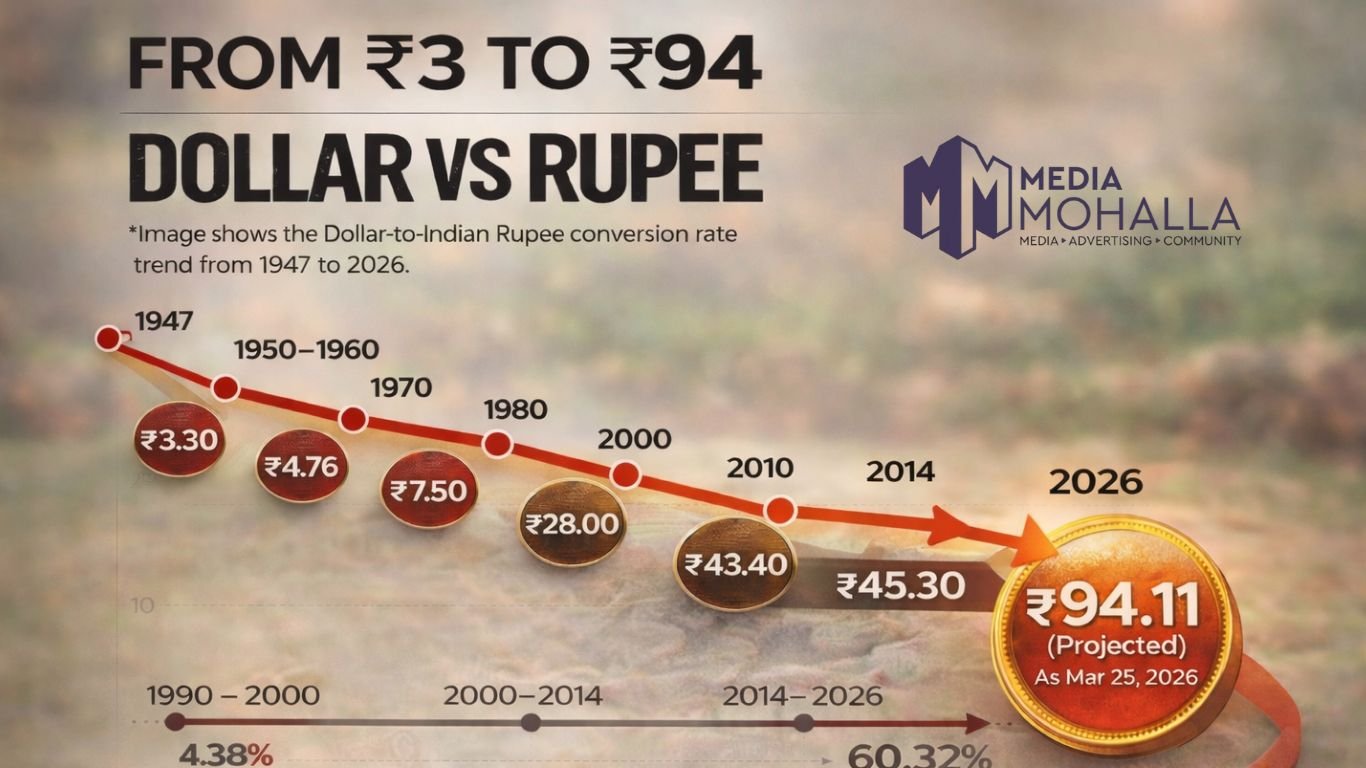
The journey of the Indian Rupee against the US Dollar is not just a story of numbers it’s a reflection of India’s economic evolution, policy shifts, and global positioning over nearly eight decades. From a modest ₹3.30 per dollar in 1947 to an estimated ₹94.11 in 2026, the rupee’s trajectory tells a deeper story of growth, crisis, reform, and resilience. Early Years: Stability with Controlled Economics (1947–1970) At independence in 1947, the rupee stood at ₹3.30 against the dollar. During the 1950s and 60s, the exchange rate moved gradually, touching around ₹4.76. This period was marked by a tightly controlled economy with limited global trade and a fixed exchange rate regime. By 1970, the rupee had depreciated to ₹7.50, signaling early pressure from rising imports and limited export competitiveness. Gradual Decline and Structural Strain (1970–1990) The rupee reached ₹8.00 in 1980 and sharply fell to ₹17.50 by 1990 due to…